Showing posts with label vegetable garden. Show all posts

Monday, August 5, 2013

Garden Report

My post about magically appearing zucchinis made me think it's about time I reported on the progress of this year's vegetable garden.

Most crushing disappointment: the onions. I should never have boasted how well we grow alliums here at Mucky Boots, because this year the onions have been a disaster. Germination was about 15%, so I replaced all my seed and began again, and still only had a 50% germination rate. All of which put me a few weeks behind. And once the seedlings made it into the garden they went on strike, and have done very poorly. In past years I have been harvesting my onions by this time, enough to almost see us through the year, but this year we'll be lucky to get a dozen onions big enough to eat. It makes me want to cry, which I guess is appropriate given it's onions we're talking about. I'm just glad the garlic did fine.


Most frivolous success: nasturtiums. My companion planting book suggests planting nasturtiums among squash plants to attract pollinators. I took this advice to heart and now my wildly vining, sprawling squash plants are entwined with wildly vining, sprawling nasturtiums in vibrant reds and oranges.


Most practical success: Cucumbers. I grew some pretty good pickling cukes last year, but my heart belongs to long, elegant English cucumbers, with which I have had no success. But this year I have four lush, healthy plants flowering like mad and already producing fruit. Best of all, I ate the first one a few days ago and it was the juicy, tasty essence of cucumber-ness.


Most gloat-worthy success: The winter squash. Unlike the zucchini, which produced three and promptly quit (why am I the only person in the universe who can't grow enough zucchini?) the winter squash plants are pumping out more squash than ever before. I have squash growing in beds, between beds, up a strawberry tower, along the ground, and even up the middle of a stand of dried up daisies. There are still a few things that could go wrong before harvest time, but it's looking good, and given my past failures in this department I'm giving myself permission to gloat.

Winners of the "Never Again" Award: cilantro and parsley. I can't grow either. The cilantro bolts the instant I turn my back, before I have a chance to harvest any leaves, and the parsley just sits in the dirt and looks at me, refusing to grow past the seedling stage. I've tried, and I give up.

Winner of the S-L-O-W-E-S-T Growth Ever Award: the cabbages. I don't know what the heck they're doing - I planted early varieties and they're barely starting to form heads. Was it too cold? Then too hot? Too wet, then too dry? They're progressing, just very, very slowly.

Winner of the "I Like It After All" award: broccoli. Last year it was kale, my formerly favourite vegetable to revile. This year it's broccoli, which I had decided, once I regained my sense of smell, I didn't like. But that was supermarket broccoli. My own broccoli, right out of the garden, lightly sauteed so it's bright green but still with some crunch, with a squeeze of lemon overtop? That's an entirely different story.

How has your garden been faring?

Tuesday, July 30, 2013

Where'd this one come from?


I have been something of a Squash Nerd this year. I've always tried to grow squash but haven't usually been very successful. I've had trouble with germinating, and transplanting, and flowering, and pollinating, and ripening. Basically I've had trouble with just about every stage of a squash's development from seed packet to dinner plate.

But I've learned a thing or two along the way. Like the fact that squash don't take to being transplanted, and that even if I'm really excited about things growing in the springtime, the squash plants aren't necessarily as excited and won't grow until they're good and ready. So now I seed them directly into the garden, a few weeks later than I used to.

And I learned about male flowers and female flowers and the whole process of pollination. I still haven't figured out why one day there will only be male flowers, and the next day only female, but I suppose Mother Nature has the right to a few mysteries.

So this year, armed with my hard-won experience, I dosed the squash beds with a generous amount of fish compost (a splurge, but so worth it), waited until the weather warmed up before seeding, and checked on the progress of the plants day by day.

They began to flower about two weeks ago, and since then, every morning I have made the trek back to the vegetable garden to search out male flowers which I would pluck, strip of petals, and then carry around from bed to bed looking for female flowers to pollinate. And of course looking for signs of success from the previous days' pollinating ventures.

So when my zucchini plant produced its first zucchini I was thrilled. I cut it off the bush, carried it proudly in the house, sliced it and marinated it in a lovely vinaigrette, ate the whole thing in one sitting, and then began waiting for the next one.

Apparently a watched zucchini plant is something like a tea kettle, because it has since produced nothing. Some flowers, which I have faithfully pollinated, but every morning as I have looked under the big leaves for any sign of an impending zucchini, there has been nothing but disappointment.

Which is why I was a little surprised to find this yesterday.


Did it grow that big in one day? I don't think so. So where, exactly, was it hiding?

Monday, July 8, 2013

When is a vegetable garden not a vegetable garden?


When it's a flower garden, of course.

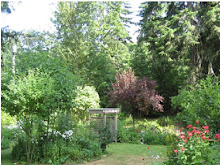
When we first moved to Mucky Boots I was a little impatient with all the flowers the previous owners had planted in the vegetable garden. Yarrow, poppies, roses, lavender, butterfly bushes, daisies. What the heck were they all doing there, I wondered. Sure, they were pretty, but I was set on being a practical, productive Serious Vegetable Gardener, and they were taking up valuable real estate.

After a year or two, once I had learned a thing or two, I realized all those flowers were attracting the pollinators to the garden. I had them to thank for all the peas, beans, tomatoes, squash, melons and cucumbers we ate. So my impatience turned into appreciation for the job the flowers were doing.

Now I don't care about what sort of function those flowers perform: I'm in love with how beautiful they are, and that's enough for me. Beauty is enough. What a revelation.

My herb bed is full of borage volunteers. I'm amazed they're there, because I haven't planted any in the vegetable garden for a couple of years.


The mallow growing in the same bed is in its third year of self seeding. I don't have to do any work at all (other than recognizing a mallow seedling when I see one, so I don't weed it out by mistake) and look at what I am given.


Remember what I said about having second thoughts about giving poppies a free ride and retracting my offer to let them grow wherever they are inclined to? Well I'm like the Fiddler on the Roof, thinking it out again, because I'm back to whole hearted infatuation. These poppies (and their friends the calendula) have made themselves at home in a bed that's supposed to belong to three blueberry bushes. I check periodically on the blueberries, to make sure they're not being smothered. They aren't - they're being beautifully adorned instead.


There are three rose plants in the vegetable garden. They mystify me. I thought roses were supposed to be fussy, demanding plants requiring dedicated care. All I do is hack them back in the fall, and they repay me by  looking beautiful all summer.


This all signals a change in how I view my vegetable garden. Our first growing season I was so focused on squirrelling food away Kim could barely get a few strawberries in her mouth before I was yanking them away to freeze for the winter. I canned and pickled and froze, and realized that while it was nice to have that food in storage, there are only so many pickles one can eat, and frozen vegetables are always a poor second compared with fresh. So I have gradually relaxed about preserving food and focused instead on eating as much fresh from the garden as we can, and growing vegetables that can either overwinter in the garden (like carrots, beets, and hardy greens) or store well (like onions and garlic). All of which means the pressure to grow as much as possible has been eased, so there is more room in my garden for all those beautiful flowers.

And there's more room in my heart, too. That's a Mucky Boots miracle.

Tuesday, May 14, 2013

Fairy godparents in the garden


A few weeks ago our neighbour's dad visited them for a week, and while he was there he pruned their entire orchard. We were sort of hoping he wouldn't realize the friendly fence between us actually marks a property line, and would continue his pruning roll right on into our orchard, but he didn't.

We know the magic of visiting parents willing to pitch in. On her very first visit to Mucky Boots my non-gardening mom weeded the entire strawberry patch, obliterating every trace of the wood sorrel that had infested it. And my dad contributed to my combat-perfectionism-by-enjoying-my-garden-more campaign by assembling new garden loungers that came in a million parts, with nothing but his engineering expertise and some badly translated instructions.


The magic of visiting parents indeed. Fairy godparents in the garden. And we're being visited by some now: Kim's folks are visiting us from Ontario, and, bless his heart, her dad is a gardener and brought his pruners.


Their very first morning here they were on a mission: Ken watered, shovelled compost and spread straw mulch while Saundra helped me plant squash. And that was just the first morning. The next day Kim fired up Johnny D and loaded up the trailer with compost, and then she and her dad started in on the backlog of plants waiting to be transplanted while Saundra weeded, kept us all hydrated, and kept me and my sore joints from overdoing it.


Friends in the garden are as good as fairy godparents, and we were also visited by some of them on the weekend: Margaret and Julie came for tea.


This was Julie's first visit to Mucky Boots, and it was so much fun trailing after her as she recognized historic landmarks from her faithful blog reading: "Oh, that's the chicken door Kim had to crawl through when she locked herself in the coop!"

When the tour was done we had tea in the garden.


Those amazing lilacs aren't ours - Ken bought them for us at the farmer's market, to help me celebrate my new sense of smell.


Tea was accompanied by a treat, of course: rhubarb coffee cake made especially for Margaret, who thinks rhubarb merits its own food group. She has a point.

Monday, January 21, 2013

Sunshine


Not only has it forgotten to rain for days and days, the sun has been shining

Is there anyone else in my neighbourhood who is as gobsmacked as me? Winters here are usually wet, wet, wet and gloomy, gloomy, gloomy. If that weren't bad enough, apparently our December tied for the fewest hours of sunshine on record for our area.

Mother Nature seems to be working overtime to make up for it, because it has been sunny and clear day after day. Crispy cold, with the temperature dipping below freezing every night and staying within a couple of degrees of that during the day. But with the sun shining, who cares? It makes me want to move to Alberta, the land of big skies and winter sunshine.


Everyone and everything is enjoying the sun, from the chickens to the vegetables to the bulbs starting to think about sprouting.


 The freezing temperatures every night have been hard on the greens still hanging on in the garden, but man, are those greens tough. This chard had no protection from the snow we had through December, but just look at it basking in the sunshine, gearing up for its spring resurrection.


The big surprise, though, has been the Bambi lettuce. I know I've gone on and on about how much I like this gem lettuce, and I've also written about how well it survived the first of the cold weather. But even after two weeks of freezing night time temperatures, with only a flimsy row cover for protection, look how well it's doing. Remember, this is lettuce we're talking about!


Most of the rest of the garden isn't looking so hot. I was a bit lackadaisical about my fall clean-up this year so there is a lot of work waiting for me once everything unfreezes. 


But as long as the sun keeps shining, who cares?

Tuesday, January 8, 2013

Getting real in the garden


It's that time of year again: the 2013 seed catalogues have come in from my favourite suppliers and now it's time to figure out what the heck I'm going to do in the garden this year.

I really didn't know anything about growing vegetables before we arrived here, and so the last four years have felt like a big experiment, full of the novelty of any new adventure. But now it's time to get real. Or at least real-er. Not that it won't still be fun - it will. But I think I have enough data and experience now to be more realistic about what I can successfully grow. Here's what I'm thinking.


Thought #1: Alliums are the stars at Mucky Boots. The very first thing we planted even before we had moved in was garlic, and we have loved it from the start. There is nothing like home-grown garlic and onions, and somehow the conditions here seem suited for it. So we grow a lot of them: garlic, leeks and shallots, and red, green and yellow onions. I'm very happy with the varieties of red (Redwing) and yellow (Copra) onions in particular - they are indestructible in storage. It may not be the most economically wise thing to do, to devote such a large amount of garden space to growing things that are so inexpensive to buy, but we continue to do it because the quality is so much higher and because it means we get the satisfaction of cooking almost every day with something we grew.


Thought #2: I should only grow what I'm willing to eat. Take beans for example. In my first year's garden I grew lots and lots of beans. Pole beans and bush beans. Yellow beans, green beans, purple beans. Soybeans, filet beans and beans for drying. Consequently I preserved a lot of beans. I pickled beans, I blanched and froze beans, I dried beans. And I learned a few things - namely that there is only so much pickled anything I am willing to eat (I'm much more likely now to reach for something fermented than traditionally pickled), and frozen beans have an awful texture. So awful that most of that first year's frozen beans ended up being given to the chickens. I thought maybe I did something wrong (I blanched for a short period of time, then shocked with ice water, then used a vacuum sealer) so the next year I followed a different set of advice and didn't blanch, I just cut up and vacuum sealed. Still awful.

And the dried beans! My third year I wanted to see how much protein I could get out of the garden so I grew two different varieties of beans for drying. They did pretty well, and I'm happy to know it can work, but it was too much bed space and labour for the result. So last year I planted four measly feet of pole beans for eating fresh, and that was even more than we wanted to eat. This year: three feet.


On the other hand, I keep planting more and more carrots and more and more hardy greens, like chard, bok choy and (gasp!) kale. Between interplanting with onions and covering seedlings with remay cloth I seem to have found a way to produce pretty decent carrots, which we can't seem to get enough of. Ditto for the greens, which seem especially suited to our climate. I can grow them, we like to eat them - this is a recipe for success.


Thought #3: Pelleted seeds are wonderful.  Last year I planted my first pelleted seeds: carrots and lettuce. If you have grown either of those vegetables you know how tiny the seeds are. Which means, unless you have much greater dexterity and better eyesight than I do, a lot of thinning. With the right mindset this can be meditative, but it more usually feels like very fiddly torture. So when I saw seeds being offered with an organic pelleting I decided to give them a try. It's kind of like a candy coating on each seed, which makes them easier to space when you're seeding them in the garden. The seeds cost a bit more, but there's much less wastage. I'm sold on them, and will continue to buy them.


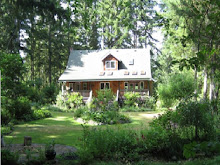
Thought #4: We live in a forest. We better get used to it. You can probably tell from this photo that our vegetable garden is in a clearing carved out from the surrounding forest. Which means it gets pretty good light, but not great light - which limits the kinds of things we can successfully grow. I've figured out we can grow pretty much anything, but not necessarily really well. Eggplant and peppers turn out puny, and winter squash seems to be a hit-or-miss proposition. So I've decided I need to be more strategic in my garden planning, and factor in the amount of sunlight each bed gets when I am figuring out crop rotations.

One crop that needs to be abandoned is grapes. There are three mature vines along one side of the vegetable garden, and we have yet to get anything resembling a harvest. There's just not enough sunlight. And they're grapes for making wine, not for eating, and neither of us is interested in wine making. To top it off, they contribute to the lack of sunlight for the vegetables. Verdict: they're coming down.


Thought #5: Berries are way easier to grow than fruit trees. When we moved to Mucky Boots we inherited a small orchard with three venerable apple trees (Pink Lady, Cox Orange Pippin and a crabapple) and a number of younger trees (cherry, Asian pear, peach and plum). We added a whole bunch more: pear, fig, more apples and plums. And we quickly learned that there is a disease and a bug for every season for every one of those fruit trees. It's hard to grow fruit!

Berries, on the other hand, seem to practically grow themselves. We have all kinds here - strawberries, raspberries, blueberries, blackberries, gooseberries and red currants - and they all do well. Every year some types do better than others, but we've never had a bad year. Plus the investment of time before they begin to produce is much shorter. So we're going to replace the casualties in our orchard (between diseases and bears we have had a few) with more berries, not with more fruit trees. We're going with the flow on this one.

Five thoughts in one day. I better quit while I'm ahead.

Thursday, December 13, 2012

Winter garden


My commitment to growing vegetables through the winter has been a little lukewarm. Our first winter here I tried to make use of a cold frame that had been left behind by the previous owners, dragging it into the vegetable garden and using it to cover one of the raised beds where I had planted some hardy greens. There were two problems with it. First, it didn't actually fit the bed, so there was lots of overhang around the bottom edge where cold air could get in, which made the whole undertaking a bit futile. And second, it weighed a frigging ton, which made it difficult to water, weed or harvest.

Our second winter I focused on root crops, like rutabagas, carrots and beets. I learned an important lesson that year: vegetables don't actually grow once the cold weather and short days hit, they just keep. So it's important to get the seeds into the ground way earlier than you think is necessary - in my case in late June or early July) so that the roots are big enough to harvest come October or so. At that point they get mulched to protect them from a hard frost and then the ground acts like a big refrigerator: when you want a carrot you just go out and get one. I didn't really clue into all that, that year, so all I ended up with were roots so small they were barely worth peeling. Except for the rutabagas, which don't get seeded until mid July anyway. They were great, that year.

Our third winter I didn't do much at all. No explanation, I just didn't. But it meant that this year I was more determined to get things right, or at least righter. I got the carrots and beets into the ground on time, and lots of them. The hard frosts we have had, plus the visiting nibbling rabbits, have done a number on the greens...


...but underneath the mulch the roots are big and tasty. A little hairy, and with a bit more bug damage, but really good for soups and stews.


The rutabagas, on the other hand, have been a bust. They developed nice big, healthy tops (at least until a band of marauding chickens got into the garden one day and demolished them) but the roots didn't bulb the way they should have. I'm guessing it was a soil deficiency of some kind, which I'll have to sort out for next year.


Cabbage is an interesting vegetable to grow. As far as I can tell there are cabbages you plant early in the spring for eating in the summer, others that you plant later in the spring for eating in the fall, others that are hardy enough to stay in the garden and harvest through the winter, and others that stay in the garden through the winter in order to have a head start in the spring. 

This year I tried planting a crop of red cabbage to harvest through the winter but my timing was entirely wrong, and they didn't grow big enough before the cold weather hit. They probably won't be in good enough shape to make spring eating, but we'll see. 

I also planted some January King cabbages that should hold their own in the garden through the winter. They got started too late, too, but unlike any of my other winter vegetables these cabbages seem to be still growing, and are developing heads - and beautiful ones at that. (There is a lovely one at the photo at the top of the post.)


The undoubted star of this year's winter garden is the Swiss Chard. I am developing quite an affection for this plant: it's hardy, good for you and apparently indestructible. Plus it looks lovely in the sun.

I decided to give growing under cover another try this year. In August Kim and I constructed a simple hoop house with PVC pipe and zip ties...


...and then in late September when the nights started getting chilly we covered it with fabric fastened to the pipes with these clever U-clips. We never did get around to covering the whole shebang with plastic, but so far the plants underneath have forgiven us and thrived. 


I planted two kinds of kale, more chard, bok choy, spinach and our standby salad green, Bambi. I have already gone on and on about how much I love this gem lettuce, and now I have even more reason. It's December, we have had plenty of cold weather, and it still looks like this.


The bok choy doesn't look as great, thanks to the visiting bunnies. We really have to see to our perimeter defences before spring.


I could get all perfectionist about this, but I think I'll just be happy I'm at least I'm in the right ballpark. Or as my dad would say, on the right side of left, and the upside of down.

Tuesday, December 4, 2012

Popcorn


You might remember that way back last winter, as I was poring through seed catalogues in search of inspiration for my 2012 garden, I struck on pink popcorn as a way to inject a little whimsy into what was starting to feel like a ho-hum routine of planning my plantings for the year.

I didn't devote much space to my first ever corn plants, just a sunny, hot and protected spot where they would have the best possible chance at accumulating the heat units they would need to produce ears. I think I had about two dozen plants in all, most of which produced at least one ear. But the thing with popcorn is that it needs to dry on the plant, which poses a challenge on the West Coast where "fall" means "rain". Some of those ears began to grow mold before they had a chance to properly dry, which meant I ended up with about a dozen adorable little pink ears of popcorn.

I must have been waiting for the stars and moon to align in a certain way, because I didn't get around to trying it until tonight. After Googling instructions for popping corn still on the cob, I put the entire cob (minus its leaves) in a paper bag in the microwave.

Which just goes to show you shouldn't believe everything you read on the internet, because this is what happened.


Smoke was pouring out of the bag like nobody's business, but fortunately I got the whole mess out onto the verandah before the smoke detectors went off. The popcorn was so smoky it was inedible. At least there were no flames...


For my second attempt I decided to go with my head rather than Google, and I stripped the kernels off the cob first. The cobs are small, so I ended up with only a couple of tablespoons of kernels, but didn't they pop up beautifully! Startlingly white, fluffy and - miracles - actually tasting of corn.


As a food-growing experiment I judge it a success. Not a practical one - each corn plant took up a fair bit of space, and to end up with a (very) small bowl of popcorn for every two plants isn't a good yield. But it was a fun project, it kept me interested in my garden through my bout of fourth-year-blues, and it has inspired me to try growing some regular corn next year. That's good enough for me.

Friday, October 5, 2012

Melon


I grew melons this year.

I still can't believe it. I can't believe it's possible to live in Canada and grow melons. I grew four of them, only the size of a softball but full of melon-y fragrance and taste. The essence of melon-ness.


Next year I'm trying pineapple.

Related Posts Plugin for WordPress, Blogger...