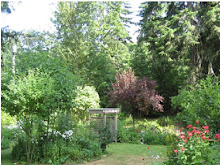
Quinoa providing a lovely backdrop for a stray poppy, in July.
I finally got around to dealing with the quinoa that has been patiently hanging around since I harvested it about 6 weeks ago. The reason for the delay has been puzzlement over exactly how I was supposed to separate the edible parts - the seeds - from the fluffy material surrounding them, not to mention all the dried leaves and stems.
I know how to Google as well as the next person, but I didn't find much to help me. There is general consensus that you need to bash the heck out of the seed heads to break apart the clusters of seeds and fluff, but past that all I could find were very brief references to "winnowing", which were contradicted in the next source by a statement that the seeds are too light for traditional grain winnowing to be of any use: the seeds would be blown away along with everything else. In the end I decided to just make it up as I went along...

The quinoa had been hanging in splendid colour outside under cover of the verandah, but once the rains started the ambient humidity was so great there was no chance they would dry. So a couple of weeks ago it got moved inside to a cozy corner of the wood-stove-heated family room. My first step was to strip the seed heads from the stalks into a big bucket. Because each stalk had numerous seed heads nestled in among all the dried leaves, this meant quite a lot of dried leaf and stem matter made it into the bucket along with the seed heads.

After a bit of experimenting, I settled on a two-step process: I would dump a big handful into a colander and gently mash it to separate out the smaller seed and fluff clusters from the bigger stems and leaves. Then I put the result into a finer sieve and rubbed and rubbed to separate out the fluff (which was fine and fell through into the bowl) from the seeds.

All of that took about an hour, and resulted in about two pounds of this: mostly seeds, but also small pieces of leaves and stems.

I figured I was most of the way there, but how the heck was I going to get the seed clean enough to eat? And then I realized that when I washed the quinoa (which has to be done before cooking because it is coated in a protective soap-tasting substance) the seed should sink but the chaff should float. So I tried it with a small amount and it worked perfectly.

I feel like this deserves a trumpet fanfare: I grew quinoa that I can actually eat in my garden!
Now for some math: 2 pounds from about 32 square feet is exactly the same yield per square foot as the Vermont Cranberry beans. How do they compare nutrient wise? After all, the purpose of growing both was to see how much protein I could produce from the garden. Since 100 g of (uncooked) dried beans provide about 23 grams of protein and the same amount of (uncooked) quinoa provides only 14 g, the beans win hands down. But since one is a legume and one is a seed, they would actually be very nice nutritive complements to each other.
Will I grow quinoa again next year? Yes, and in fact I'll grow more. It was a great crop for this part of the world: sturdy, drought tolerant and nutritious. I didn't have to fuss over it, it germinated well, it looked gorgeous in the garden all season long and, best of all, it's already part of my regular diet so I don't have to learn to like something I really can't stand (can you spell K-A-L-E?). What's not to like about that?