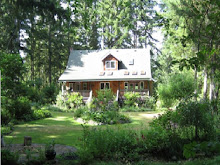
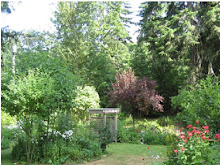
I was pretty much new to gardening when we moved out here to Mucky Boots. There was one small vegetable garden a long time ago that my house mate was mostly responsible for, and I remember a few failed planters on decks and balconies. At our house before this one we had quite a bit of landscaping, but all it really needed was maintenance, and so I learned something about how to weed, cut things back, and spread mulch.
So I think I don't need to tell you what a steep learning curve I have been on in our three years here. I have learned a lot about growing vegetables, and a bit about growing perennials, but I think the best lessons, the most important ones, have been about the graceful embrace of imperfection and the ebb and flow of the seasons. And about the acceptance of enough. Enough food grown. Enough work done.
And so here are a few of the lessons about life and about gardening I have learned.
 Don't push the season
. When we first started I was determined to get as much food from the garden as I could, and that meant starting almost everything in the greenhouse. I have learned that a lot of time and energy - and money, for all those heat mats - go into all those early starts, and a lot of it can be saved by just paying attention to what the plants really need. By starting winter squash in the greenhouse, for example, I had it in the ground earlier than I would have if I had just seeded directly, but by the time the early birds had recovered from their transplant shock, their direct seeded cousins had caught up. Or take beans, as another example. They really need warm soil to germinate, so there is no point seeding them before the soil is ready - they will just rot, or at best sleep until the conditions are right. This can be applied to my life, too: sometimes, when I'm trying to force something to happen
right now, what I really need to do is step back and wait. I'm not so good at that, but I'm learning.
 Be satisfied with enough
. Sometimes ten tomato plants are enough, and I don't really need twenty-four. Sometimes one bed of blueberries is enough - three would mean lots more blueberries, but also lots more work. Sometimes stopping to admire one gorgeous tulip is enough, without leaping to thinking I need to plant a whole bunch more. Sometimes it's enough to stop after two of three hours of work, even though it means leaving a lot undone. Being satisfied with enough is about getting off the treadmill of
more, more, more, and sitting on the porch with a cup of tea and enjoying what
is instead.
 Enjoy the first blush of spring and don't be sad when it's gone
. There is a magic week or two in May when tulips, and iris, and columbine, and perennial corn flowers, and lilacs, and wisteria are all flowering. Everything is lush and green, and all is right with the world. Then I notice that ants have got at the climbing hydrangea again and those corn flowers are looking slightly mildewy, and the tulips fall over and look blah. I've learned not to worry - the hydrangea will survive, and the hostas are already growing in leaps and bounds to fill in the empty spaces, and soon the poppies and lilies will steal the show, and then the glorious fall colours will start, and then the quiet of winter will come, and then it will be spring all over again.
 Choose your battles
. Creeping bellflower. Some of my beds are full of it. I briefly tried to eradicate it, but there's a reason it's classified as an invasive species in some districts: you can dig and dig and sift and think you've got every last root and rhizome, but an inch further down are some you missed that are already planning their comeback. Here's how I look at it now: in the early spring it forms a lovely, lush green ground cover. A few weeks later, once the stalks are about a foot high, they are easily pulled out to give the other plants more room. Of course that's just the stalk, and all the roots are left behind, but I wasn't ever going to be able to rid of those anyway (see above) so now I mostly don't bother unless I am planting something new and want to give it some breathing room. I see it as a perfect example of the 80-20 rule: in 20% of the time I can deal with 80% of the problem, but to finish off the remaining 20% would take 80% of the time. Get it?

Poppies growing in the thyme patch.
Give poppies special dispensation. Our first year here I spent a long afternoon ridding the rhubarb and blueberry bed of what I thought were dandelions. Turns out they were poppies. I love poppies. They are a perfect example of a beautiful thing that can't be controlled or owned: they grow anywhere and everywhere, and you have to appreciate them in situ because they make terrible cut flowers. Now poppies get a free ride here at Mucky Boots - I'll leave them in any bed they appear in except where I'm trying to grow carrots. It's good for me to have something in my life that doesn't follow rules or plans or schedules, something that can't and shouldn't be controlled. That's the gift poppies bring me.
What have you learned from your garden?