Friday, January 21, 2011

Taking stock


I have been wrestling with a tricky question: what, exactly, is the point of my vegetable garden?

There is an obvious answer: to grow vegetables. But it feels more complicated than that to me. Should I...
  • grow vegetables that are expensive to buy or difficult to find in stores? (such as heirloom tomatoes or purple potatoes)
  • grow vegetables that are good for me to eat? (such as kale)
  • grow vegetables that I like to eat? (such as anything except kale)
  • grow vegetables that will keep well? (such as winter squash and dried beans)
  • grow vegetables year round? (such as salad greens in the winter)
  • grow as many vegetables as I can, or just as many as I want?
  • grow vegetables in order to prepare for some kind of disaster, or simply to enrich my life now?
The last question is probably why this all feels so complicated to me. I have written before about the murky overlap between self-sufficiency and survivalism. I am one of those people who worries about disasters, so part of me wants to grow and squirrel away as many dried beans and potatoes as possible. But I also don't want to live in fear - I worry too much already about too many things.


The book The Resilient Gardener: Food Production and Self-Reliance in Uncertain Times by Carol Deppe has been mentioned on a few blogs I read, and the title struck a chord. I bought the book, read it, and believe that it has given me a way to find my footing in that murky overlap. I won't go into all the details, but the most important message for me is that gardens need to survive all kinds of problems from major crises (like earthquakes here on the West Coast, which could make food self-sufficiency important in the short term, and climate change, which will change the conditions under which our gardens grow) to minor crises (like an arthritis flare-up that can put me out of commission for a few weeks, causing my garden to have to fend for itself). The best kind of garden is one that can accommodate a variety of changing conditions - a resilient garden. And the best kind of gardener is one who learns the skills she may need to manage both kinds of crises during less demanding times, like right now.


Take dried beans, for example. I dabbled with them my first year, and harvested about a pound. They took a fair amount of effort to grow and harvest, and a whole lot of work to convert them into a pot of baked beans (boy, do I need a pressure cooker...). The payoff didn't seem worth the investment of time and labour, especially since I can buy relatively inexpensive organic dried beans at the grocery store. So last year I didn't bother with dried beans.

But I thought about it a lot through the growing season. Dried beans are practical, because they have a great nutritional punch, and they don't require freezing or canning for preservation. It didn't feel entirely right, not growing them. After reading The Resilient Gardener, my thinking has resolved itself: it may not be a sound investment of my time and effort in the short-term to grow dried beans, but it's a skill I would like to have if I need to count on it some day. So this year half my bean bed will be devoted to Vermont Cranberry and Kenearly Yellow Eye beans for a dried bean harvest.

The same could be said of seed saving. Spending a few dollars on seeds every spring isn't such a bad thing, compared with the work it takes to save your own, but that's another skill I would like to have in case I ever need it. Carol Deppe gives good instructions for properly fertilizing squash plants, to ensure the seeds you get actually produce the right kind of squash the following year instead of some weird hybrid, so I'm going to give that a try.


Speaking of squash, Carol Deppe is very big on squash as a nutritious source of food that stores well. So I am making squash a big priority when it comes to allocating bed space: the 34-foot-long bed of artichokes is going to be emptied to make room for squash. Lots and lots of squash: Sweet Meat, Burgess buttercup, Spaghetti, Waltham butternut, Honey Bear acorn, Sugarloaf delicata and Sunshine kabocha. We like squash anyway, and could always eat more of it, so I am comfortable focusing on growing squash to provide food for ourselves year round without feeling like I'm obsessing over disaster scenarios.


Speaking of food year round, I haven't had a good track record when it comes to keeping the garden producing through the winter. The best I've been able to manage so far is to make sure I have rutabagas, leeks, beets and carrots in the ground when the cold weather hits. They last well through the winter - until they're eaten, that is. I've given half-hearted attempts at sturdy greens, like chard, mizuna and other Chinese greens, but my interest seems to flag about the time the water freezes in the outdoor hoses, making watering the plants in the greenhouse a real pain. I had the same problem my first year watering under the poly tunnels. Thinking about this, I've decided to try to do a better job with chard but stop bothering (at least for now) with salad greens. I just don't feel like eating salads in the winter; I want warm comfort food instead. Growing chard through the winter in the greenhouse will mean carting water from the house for watering, but once each week should do it. I can manage that.

It feels like I'm walking a bit of a thin line between taking pleasure in being even slightly self-sufficient when it comes to food, and obsessing over it because I'm worried about a catastrophe of one kind or another. I know I worry too much about lots of things, but Carol Deppe is helping me take a bigger, calmer, more practical view. Thanks, Carol.

Monday, January 17, 2011

Prescription


I heard on the radio today that some mental health professional has determined that January 17 is the most depressing day of the year. It has something to do with the post-Christmas blahs, post-Christmas debt, not enough sunlight and the dawning realization that all those New Year's resolutions are going down the drain yet again.

Wasn't that a cheery news clip?

I don't think I'm in danger of depression, but Kim and I have been feeling a little whomped with weather. Last week's big dump of snow morphed this weekend into mud, mud and more mud, and we were reminded that it was under similar conditions that we named this place Mucky Boots Farm. And we've been plugging along painting railings and installing baseboards, both of which are fiddly and neither of which is giving us much satisfaction.

So I was in need of a little cheering up, some kind of reminder that spring is on its way. Lucky for me the sun came out today, I could see the mud puddles starting to dry, and best of all: green shoots in the garden.


There's no better prescription for January blahs than the first evidence of snowdrops poking through the mulch.

Of course Frankie's version of a green prescription is his green B-A-L-L. No sign of blahs there.

Wednesday, January 12, 2011

Oh, brother


More snow.

This may not seem unusual to those of you in other parts of the world, because in most people's heads Canada = Snow, right? But we live on southern Vancouver Island, otherwise known as Lotus Land. We're supposed to be safe from the normal trials and tribulations of winter - yes, we get a fair amount of rain through the darker months, but that's not so bad.

When we first moved to Victoria from Toronto, it happened to snow in about November. Not much - a couple of inches. So we got out the snow shovel and tackled the long driveway, wondering why our neighbours weren't doing the same, but were looking at us with puzzled curiosity. About 6 hours later we found out why: the snow had all melted.

That has been our usual experience with snow here. We get a couple of snowfalls each winter, nothing to write home about by most people's standards, and it melts quick enough that the common approach to dealing with it is to sit by the fire with a cup of tea until it melts.

Well, someone changed the rules and forgot to tell us. Our first winter here at Mucky Boots saw record snowfalls - impressive amounts even by prairie standards. It was tough, because the guy installing our flooring kept getting stuck, and it made commuting a bit hairy. But we took some consolation in the fact that it was really, really unusual.


[The snow was this high that winter. We shovelled and shovelled and then we made friends with Bruce the Backhoe Guy.]


But here we are, two winters later, and we keep getting snow. Snow and more snow. It's not as bad as the first winter, because it warms up enough between dumps that it eventually melts and we get to start fresh with the next snowfall. But it's still a pain and I can't help feeling a little...cheated.

It snowed again last night, about 18 inches. Deep enough that this morning Frankie had to make bounding antelope leaps to get from Point A to Point B. Deep enough that it won't be melting anytime soon, so I spent a good long while trying to shovel out the driveway. Deep enough that I had to concede defeat and go inside to cancel all my tutoring sessions for the day. Deep enough Kim had to shovel out the normally protected chicken run just to get into the coop to take care of the chickies. Deep enough the chickies are sensibly opting for indoor recess today.


I have learned there is a snowfall hazard unique to living in the middle of a forest: the avalanches of snow that happen when a big tree sheds its snow load. I learned that lesson the hard way this morning. I'm still drying out.

Sunday, January 9, 2011

Off-duty


It snowed again last night. It's freezing outside. The fire's warm.

What's a Quality Control Advisor to do?

Saturday, January 8, 2011

Railing


Kim and I never seem to have just one project on the go at a time. Currently we're trying to make the last tile and fixture decisions for our bathroom renovation (tear-out starts in five weeks), we're still installing baseboard and trim in a bunch of different rooms in the house, and we're determined to get the powder room finished before our next house guests arrive in February. Oh, and I'm painting the railing of the staircase up to the top floor.

Forty-eight spindles and five posts. Three coats of paint. Enough said.

Petunia-Tooter-TunaHead-TooterMuffin is my Quality Control Advisor. So far, so good.

Tuesday, January 4, 2011

Broodiness 101


Our chickens are a happy and healthy bunch. But recently a little problem has emerged among the hens: they are going broody.

Broodiness has nothing to do with channeling one's inner Heathcliff. Instead, it describes a hen (like Orange Left in the photo above - and yes, we really do need a better name for her) when she gets into her head that she should be sitting on eggs in order to hatch them. You know your hen is broody when she stops laying, won't leave the nest box, and makes a sound like a mad cat when you get near. A hen can go broody without actually having any eggs underneath her, and her broodiness can be so unshakable that she won't even leave the nest to eat or drink and ends up wearing herself down. If you want chicks, having a broody hen can be wonderful, but this is definitely not the time of year to give it a try. As a result we have been researching ways of politely convincing a hen that her broodiness is not such a good thing.

Step #1: Take the hen off the nest. For some hens all it takes is forcibly removing them from the nest box and plunking them outside. They will shake their heads, have a really big dump (excuse me for the graphic nature of this post) and then go on their merry hen way. Other hens will refuse to even stand up. I've seen Kim holding a hen in the chicken yard saying "Snap out of it!" while the hen tucks her feet up and refuses to touch the ground. If that happens, we move on to ...

Step #2: Isolation in a nest-free environment. At night time this might mean bunking in with Hector and the Hens (the Australorp bunch), or for really hard cases, going solo in the entryway of the coop that has a roost but no nest box and not even any soft litter on the floor. During the day this means solitary confinement in part of the chicken yard with no access to the coop and its lovely nest boxes.

So far these steps have been sufficient to convince our broody girls they would be better off if they just got back to the business of laying eggs. But just to help them retain their improved attitude, we hung a reminder in the coop.


Pay attention, Orange Left!

(And thank you, Mary Engelbreit.)

Saturday, January 1, 2011

Pee-wee the protector


You might remember Pee-wee as the rooster that came with the flock of Buff Orpingtons we got from Ev last summer. Despite his enormous size he's quite gentle with the hens. But when it comes to his role as protector of the flock he's all business.

This role keeps him quite busy: with the chickens free to roam between the chicken yard and the orchard, thanks to Chicken Alley, Pee-wee spends a lot of time going back and forth, checking on the hens laying in the coop, supervising the feeding frenzy when Kim comes with some scratch for a treat, monitoring the fence lines, and watching for danger.

I've been thinking of this role as largely symbolic, because ever since we put up the disco dance streamers we haven't had any trouble with eagles. But Pee-wee proved his worth this week - twice.

The first time was when Frankie bolted through a momentarily opened gate into the orchard. He's never done that before, but he really wanted to bark at our neighbour Nick who was on the other side of the fence. So he charged in and barked for about 3 seconds until he realized the orchard was full of chickens and there was a much better game to be had: chicken chasing. So around and around the orchard he went, barking madly, having a great time and causing eruptions of squawking pandemonium everywhere he went. He wasn't interested in hurting the chickens, but he was a threat all the same - and in charged Pee-Wee, hackles up and making a beeline for our dog. What a hero! We were so surprised at Pee-wee's bravery that we momentarily forgot to chase Frankie, then we came to our senses and got our dog the heck out of the orchard before a real battle ensued.

Then the other day I was taking advantage of the nice weather to get a bit of garden clean-up done around the house, when I heard a repeated, insistent crowing coming from the back of the property. I knew it had to be Pee-wee, but I'd never heard him make such a trumpeting call before. So I put down my rake and headed back to see what was up. And what was up was that one of the hens had forced her way through the fence between the orchard and Nick's garden, and was wandering along the wrong side of the property line. Pee-wee clearly didn't like it, and was continuing to make that particular call. All the other chickens had clustered around him, and the misplaced hen was zigzagging back and forth along the fence, looking for a way to rejoin the flock. I fetched Kim from the house and we rescued the hen and Pee-wee looked as happy as a stern rooster can look to have his flock back together again.

Pee-wee earned his keep this week. Good Pee-wee!

Thursday, December 30, 2010

Margaret and Mary visit Mucky Boots


Margaret and Mary drove up from Victoria today to have lunch with us. Margaret comes regularly, and sometimes brings our friend Mary with her, and we just love their visits. We love the great conversation and easy laughter, we soak up the encouragement and all the "oooohs" and "aaaahs" at our latest construction project, and their visits are always the perfect excuse to lay out a great meal for sharing.


This visit had a secondary purpose: Margaret wanted to collect some eggs. She grew up on a dairy farm in Yorkshire and has fond memories of egg gathering. Yesterday we gave the hens a pep talk to encourage them to produce some especially lovely eggs for her today, and they obliged.


The eggs were lovely, but Hector stole the show, letting himself be picked up by both our visitors for a cuddle and a photo op. Good boy, Hector.


On a completely different note, we had a frosty night here last night, and all day the temperature hovered around freezing. Kim found the strangest frosty-snow-like stuff growing on some pieces of wood in the chicken yard this morning. It looks like hair, or very fine feathers, and it's definitely frost because it melted away to nothing when we touched it.


After marvelling at it and taking some photos this morning we left it on the porch and discovered this afternoon that it had continued to grow all day. Has anyone ever seen this before? And what on earth causes it?


Added note: Kim at Golden Pines is bang on: it's called "frost flowers" and here's what the Guide to Frost says about it:

Some of the stranger ice formations you're likely to find in the woods are called "frost flowers" or "feather frost". A typical example looks like a small puff-ball of cotton candy, a few inches across, made up of clusters of thin, curved ice filaments.

Frost flowers usually grows on a piece of water-logged wood. It's something of a rare find, meaning that conditions have to be just so before it will form.

Not much has been written on this unusual phenomenon, and to my knowledge it has never been reproduced in a controlled laboratory environment. It appears that the ice filaments are essentially pushed out from pores in the wood as they freeze.

It's something of a misnomer to call this frost, by the way, since it freezes from liquid water, not water vapor.

Wednesday, December 29, 2010

Welcome back friend


My shadow. I haven't seen this for a long time. The sun is out today, and the forecasters promise about a week of sunnier than normal and colder than normal temperatures. I'd say that's a fair exchange.

We've been busy working on the house - specifically painting and installing baseboard in the living room and finally, after two years, in the bedroom upstairs. It always amazes me what a difference a coat of paint can do, and after years of living with the raggedy edges of baseboard-less rooms, it feels so nice to see something more finished.

While Kim takes the lead on the baseboard front today, I've been getting ready for the return of more friends: Margaret and Mary, who are coming for lunch tomorrow. So I've been making veggie pate and bread, and a vegetable soup with tomatoes, red beets, yellow beets, carrots, garlic, onions and leeks all grown this year at Mucky Boots.

A visit from friends, hot soup on a cold day, my sweetheart trotting up and down the stairs with pieces of baseboard, Frankie playing B-A-L-L in the sunshine: that's home to me.

Sunday, December 26, 2010

Walk in the woods


Kim and I have been making the best of this strange Christmas we're having, with the unexpected cancellation of our trip to Toronto to see my family. But even though some parts of this holiday aren't what we had planned, other parts could have been predicted - like the eating too much chocolate part. So yesterday, after opening our gifts and paying a Christmas visit to the chickens in the orchard, we put on our walking boots and headed for the path by the river.

I think all our neighbours must still have been snuggled by the fire at home because we didn't run into anyone on our walk. So it felt quite otherwordly: quiet, misty, mossy and a tiny bit spooky because of the fresh bear-prints-in-the-snow Kim encountered on her last walk here.

No bears this time, thank goodness.


Tuesday, December 21, 2010

Looking for beauty


I'm really glad to see the other side of the winter solstice - if the days had become any shorter I was ready to start hitch-hiking towards the southern hemisphere. It has been (typically) grey and dreary - and so dim, even during the day, that it's hard to keep my point-and-shoot flash from going off when I take photos outside.

I went looking for some beauty today, something to keep me from feeling as gloomy as the weather: we have had to cancel our Christmas trip to see my family because of a sinus condition I can't resolve before the flight. So I tried to feel grateful it's just my sinuses and nothing worse, to count the blessings of friends happy to set two more places at their Christmas dinner, to be joyful on Frankie's behalf that he won't have to spend the holidays in a kennel. And I went outside to see if my sleeping, rooted friends in the garden could bring a bit of peace to my heart.

Of course they did.


Sunday, December 19, 2010

Taking stock and looking ahead


Yes, it's that time of year: the vegetable garden looks a sight, thanks to a fall clean-up that didn't quite get finished, a flock of chicken tourists that made themselves at home before the construction of Chicken Alley, and the usual ravages of a soggy and snowy winter. But the first seed catalogues arrived in the mail last week and in my mind this garden is already next summer's verdant landscape of healthy and productive vegetables, herbs and berries.


First, though, a moment of reflection on the growing season past:
  • Most spectacular success: the carrots. They were fabulous. Row covers are definitely the way to go.

  • Most spectacular failure: the potatoes. For every chunk of potato I planted we got one or two small little nuggets. The plants never flowered, and withered and died way sooner than they should have - both in the two beds they were planted in, and also in the ten big tubs. I can only think it must have something to do with the fact I mulched with straw - apparently a standard practice in the east, but Carol Deppe says in The Resilient Gardener that it doesn't work in the Pacific Northwest. I won't do that again.
  • Most conspicuous absence: the summer squash. We harvested two small zucchinis. That's it.
  • Most ubiquitous presence: the peas. After the mice's shenanigans, we found them sprouting everywhere.

  • Bye-bye to: (1) Radishes. I don't much like them, and neither does Kim. I think I was only growing them because they are something to harvest from the garden in the early days of the season when I'm just dying to harvest something. (2) Artichokes. We won't do away with them, but they're taking up a huge amount of valuable real estate for very little food pay-off. So we'll transplant them to the perennial garden where they can look beautiful, defend themselves against the deer, and we can still eat the occasional artichoke when the fancy strikes us.
  • Newcomers: I tried growing cucumbers, peppers and melons for the first time. Then we had a record-breaking cold and wet spring and early summer - not so good for plants that need heat, heat, heat. We harvested a couple of small cucumbers - and they were tasty enough that I'll try again. I also grew cabbage for the first time, and even though the outer leaves had to be discarded because of disgusting slug-like things, what was left was great.


  • Kim's 2010 food obsession: blueberries. Our first year it was potatoes. This year it was blueberries, with two new long stretches of bushes, and newly pampered and productive older bushes to show for it. It was a good year for blueberries, but not for blueberry preserves, because we ate them all. Yum.
  • Lessons learned: (1) It's really important to cure winter squash properly if you want them to last in storage. Our delayed growing season meant the winter squash needed every possible day to ripen, which meant I ran smack up against the start of the cool, wet autumn, which meant I should have brought the squash inside to cure where it was warmer and drier. But I didn't, and they went moldy. Fortunately we could eat them before they got too bad. (2) Don't believe everything you read in a book, and if you must, be sure it's written by an author in a growing region similar to your own (see spectacular failure, above). (3) Don't overplant the peas, or you'll end up with a beautifully tendrilled chaos that makes it too hard to actually find the peas for picking.

"Now onto the new," she says, rubbing her hands in anticipation. Introducing the 2011 Mucky Boots Vegetable Garden.
  • What I'll plant more of: winter squash, cabbage, dried beans and yellow storage onions. I devoted half a bed to the yellow onions this year (as well as additional space for red onions, green onions and leeks), and even though we harvested a whole bunch of them, they're almost all gone. Onions are dead cheap to buy in the grocery store, but there's no comparison to home-grown. Two years in a row ours have been crispy, juicy and incredibly flavourful. We want more.

  • What I'll plant less of: summer squash. Even though I was initially disappointed that our summer squash went AWOL this year, I realized I didn't actually miss all that zucchini and patty pan squash. So this year I'll plant just one of each.
  • New plants for 2011: broccoli raab, Brussels sprouts and Napa cabbage, plus some winter squash varieties I haven't tried before.
  • Best recycled gardening resolution: fertilize. All the beds get treated to lovely fresh compost in the spring, but after that the plants have had to pretty much fend for themselves. You might remember I resolved to do a better job with fish fertilizer, and compost and nettle teas, and I did do it this year...um, maybe once.
  • Most eagerly anticipated crop: the gooseberries, which is pretty ironic given they were this close to being dug up. But the lone 3/4-filled jar of gooseberry and lavender jelly I made has changed my mind forever about these berries.
And now I'm off to the garden to clean up after the chickens and dream of spring.

Wednesday, December 15, 2010

Mucky Boots still life


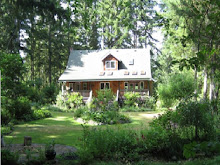
When Kim and I first saw this place we were enchanted - by the house that looked like a cabin, by the beauty of the property, and by the fact that the farm infrastructure was already in place.

The problem with being enchanted is you can't be objective. So we didn't really see a few significant problems: that the outbuildings either hadn't been finished or hadn't been maintained and would need significant repair. That the lovely deep verandah and surrounding coniferous trees would mean we would be fighting for light inside the house. And, especially, that the house needed work from top to bottom.

All the bathrooms. The kitchen. Almost all the flooring and baseboard. Both staircases. Every light fixture. Every wall would need painting.

What were we thinking? As Kim said the other day, "Were we stupid?!"

This came up when Kim ripped the carpet from the staircase that goes up to the top floor. It was dirty and stained, and carpet isn't very practical in a family with hairy pets and dust allergies. But we haven't been able to come to a decision about what to do instead.Finishing stairs can be tricky, and probably more fiddly a job than we want to take on. We'll probably end up doing a bit of patching of the rough lumber, then paint it with a really thick, durable floor paint and install a runner up the center. Ditto for the staircase down to the lower level.

But that's going to have to wait a bit, because the biggest project still waiting for us is the master bath upstairs. There is no bathtub. The floor is old lino. The toilet, sink and shower are hopelessly iron-stained from the days before the house had a water treatment system. We're looking at gutting it and starting from scratch, and I am happy to say we are smart enough to let the experts do most of this job. And there's no point finishing the staircase until the construction traffic up and down the stairs is done.

And at the same time we're getting estimates on the bathroom and trying to make decisions about the two staircases, we're trying to finish up the painting and baseboard on the main floor. Not to mention the powder room we got to the drywall stage before spring called us outside.

Hence the "Were we stupid?!" remark.

When people imagine our lives here they think of natural beauty, of a still-life composed of fresh veggies, fruit and flowers. Okay, there's some of that. But here's the real Mucky Boots still life.


I used to feel stressed about all this, but I don't any more. There is still lots to be done, but with the exception of not having a bath tub, everything is now functional and comfortable. Or maybe it's because we've already done things I never imagined we could do, so what's left doesn't seem so scary.

It just feels like a big adventure. A messy one, but kind of fun all the same.

Friday, December 10, 2010

Chicken Alley


By now you probably have an appreciation for how dedicated Kim is to her chickens. She feeds them. She scrubs out their water fountains. She researches shelter designs. She plants fields of rye for them. She studies chicken psychology. She builds things: enclosures, gates, nest boxes, chicken tractors. Where her chickens are concerned, no effort is too great, and no problem unsolvable.

Take the issue of pasturing, for example. "Pasturing" means providing chickens access to fresh grass and weeds and bugs, usually in a pasture (go figure...). Pasturing is good for the health of chickens, and for the nutritional value of their eggs. That was why Kim planted the field of rye in the fall, to make sure the chickens had access to grass even after they had reduced their chicken yard to dirt.

Well, that field of rye didn't last very long. It was so tasty, the chickens demolished it in no time, and Kim was forced to look elsewhere for a pasture. The problem is, we can't let the chickens roam free because of the two cats, one dog, and family of resident eagles.

Quite naturally, Kim's eye fell on my carefully tended vegetable garden, now mostly quiet except for leeks, beets, carrots and rutabagas still in the ground waiting to be eaten. "Naturally" because it's right next door to the chicken yard, because it's fenced, and because all the paths are lovely long, lush grass. Not to mention the fallow beds are probably full of weeds and bugs.

So Kim built one of her ingenious chicken doors in the fence between the chicken yard and the vegetable garden, and with the help of some "Here chickie, chickie, chickie" calls and a few handfuls of judiciously scattered scratch, she trained the flock to scoot through the door into my vegetable garden that is a veritable Garden of Eden.

Was a Garden of Eden. It's a mess now. Those chickens are very good at scratching and digging, which is just great unless you have raised beds. Now those beds are very well cultivated and almost certainly weed free, but the top two inches of soil is scattered all over the surrounding ground.

So I protested, and Kim's eye turned to the orchard, which is on the other side of the vegetable garden. The big problem: how to get the chickens from the coop to the orchard. The solution: Chicken Alley.


Kim used some plastic fencing and a few spare poles to create a pathway from the chicken yard...


...all the way through the vegetable garden to the orchard. It's like a chicken chute: when the door gets opened the chickens run through the chute as fast as they can, eager to get to the green grass of the orchard at the other end.


Once they're in the orchard there is food and water and the chicken tractor to shelter in if it's a rainy day. The doors at either end of Chicken Alley stay open through the day so the chickens can go back and forth between the orchard and the chicken yard, to lay an egg in a proper nest box, for example. I was concerned they would just fly over the fencing used to make Chicken Alley, because it's only three feet high. But after a few days of commuting, the birds now seem to view the chute as just that, and have stopped making excursions into the vegetable garden.

Clever chickies. Clever Kim.

Monday, December 6, 2010

C***-a-doodle-doo


It's still difficult to get a focused photo of him because he still runs away from the hens, but Hector, our hitherto mute rooster, crowed! It sounded a little weird - sort of strangled - but it was an official crow.

Our sweet boy is growing up!

[For those of you wondering about the odd title for this post, just fill in the missing letters for yourself and then take a few moments to ponder how many creepy internet crawlers might find their way here because of that title...]

Sunday, December 5, 2010

Perfect day


We put a new roof on the chicken coop yesterday. The existing roof wasn't that old, but it didn't have enough overhang to protect the joists, and as a result damp was seeping through to the interior of the coop. Not good for our chickies.

As usual, it wasn't as simple as putting on the metal roofing panels. First we had to play lumberjack, and cut down the junky alders that were growing right up against the back of the coop. Which meant a trip to the chain saw store to get our blade sharpened. And we had to special order the roofing panels because we needed an odd size. But this morning we got to it, and it only took a couple of hours. We love metal roofing.

Plus, we had help. The chickens were cheering us on from ground-level and, as you can see, one even climbed the ladder to offer her help. What a nice chickie-chickie.

Or maybe she was just lodging a complaint about all the noise interfering with her laying...

Then in the afternoon I was part of the host choir for a sing-along performance of the Messiah. There is something holy (and I say that as a non-religious person) about people singing together - and what gorgeous music to be singing.

So it was a perfect day, one that feels symbolic of my new life: new roof on the coop in the morning, singing the Messiah in the afternoon. How lucky can one person be?

Friday, December 3, 2010

Guess who came to dinner


That's right: Big Boy. Only he wasn't a dinner guest - he was the dinner.

Big Boy ended his walk on Death Row on Tuesday, when we took him to the local chicken slaughter house. Even though this was a return trip for us, it wasn't a whole lot easier than the first time.

When we brought him home I looked at the skinny, long-legged carcass in the plastic bag, thought of his three brothers in the chest freezer, and deliberately put him in the fridge instead. No more delaying: it was time to see if we could actually eat a chicken we raised.

I did a bit of research before I started cooking. According to the experts, since Buff Orpingtons aren't meat birds, Big Boy was likely to be scrawny (which he was) and tough, which meant I had to chose my cooking method carefully. I opted for Coq au Vin (the two-day Alton Brown version) and got started yesterday.

The first step was to cut the carcass into portion-sized pieces. I have broken down chickens before, but never like this: a full 30 minutes of wrestling with kitchen shears and sharp knives later, Big Boy was finally in pieces. And what funny pieces. I have never seen such long skinny drumsticks, and such concave breasts. The meat was very dark, and those thighs! Muscular hardly says it.

After 90 minutes of preliminary preparation yesterday, an overnight sleepover in a winy marinade and three hours in the oven today, we finally sat down - with some trepidation - to a Big Boy dinner. We cheated a bit by stripping the meat off the bones, so we weren't faced with a leg in our dinner bowls, and that made a difference. The meat's texture was more like beef than chicken: it was tender from its long slow cooking, but with long fibers like a piece of roast beef. And it had a much stronger taste than the chicken we're used to eating.

The final verdict: we'll eat the other three roosters in our freezer, but I don't think either of us will really look forward to it, just from a culinary perspective. But we both feel like we passed the farmer test, and will look with open minds at the possibility of raising meat birds (which should produce plumper, more chicken-like meat) in the spring.

Thanks, Big Boy. You'll make good leftovers.
Related Posts Plugin for WordPress, Blogger...