Sunday, December 19, 2010

Taking stock and looking ahead


Yes, it's that time of year: the vegetable garden looks a sight, thanks to a fall clean-up that didn't quite get finished, a flock of chicken tourists that made themselves at home before the construction of Chicken Alley, and the usual ravages of a soggy and snowy winter. But the first seed catalogues arrived in the mail last week and in my mind this garden is already next summer's verdant landscape of healthy and productive vegetables, herbs and berries.


First, though, a moment of reflection on the growing season past:
  • Most spectacular success: the carrots. They were fabulous. Row covers are definitely the way to go.

  • Most spectacular failure: the potatoes. For every chunk of potato I planted we got one or two small little nuggets. The plants never flowered, and withered and died way sooner than they should have - both in the two beds they were planted in, and also in the ten big tubs. I can only think it must have something to do with the fact I mulched with straw - apparently a standard practice in the east, but Carol Deppe says in The Resilient Gardener that it doesn't work in the Pacific Northwest. I won't do that again.
  • Most conspicuous absence: the summer squash. We harvested two small zucchinis. That's it.
  • Most ubiquitous presence: the peas. After the mice's shenanigans, we found them sprouting everywhere.

  • Bye-bye to: (1) Radishes. I don't much like them, and neither does Kim. I think I was only growing them because they are something to harvest from the garden in the early days of the season when I'm just dying to harvest something. (2) Artichokes. We won't do away with them, but they're taking up a huge amount of valuable real estate for very little food pay-off. So we'll transplant them to the perennial garden where they can look beautiful, defend themselves against the deer, and we can still eat the occasional artichoke when the fancy strikes us.
  • Newcomers: I tried growing cucumbers, peppers and melons for the first time. Then we had a record-breaking cold and wet spring and early summer - not so good for plants that need heat, heat, heat. We harvested a couple of small cucumbers - and they were tasty enough that I'll try again. I also grew cabbage for the first time, and even though the outer leaves had to be discarded because of disgusting slug-like things, what was left was great.


  • Kim's 2010 food obsession: blueberries. Our first year it was potatoes. This year it was blueberries, with two new long stretches of bushes, and newly pampered and productive older bushes to show for it. It was a good year for blueberries, but not for blueberry preserves, because we ate them all. Yum.
  • Lessons learned: (1) It's really important to cure winter squash properly if you want them to last in storage. Our delayed growing season meant the winter squash needed every possible day to ripen, which meant I ran smack up against the start of the cool, wet autumn, which meant I should have brought the squash inside to cure where it was warmer and drier. But I didn't, and they went moldy. Fortunately we could eat them before they got too bad. (2) Don't believe everything you read in a book, and if you must, be sure it's written by an author in a growing region similar to your own (see spectacular failure, above). (3) Don't overplant the peas, or you'll end up with a beautifully tendrilled chaos that makes it too hard to actually find the peas for picking.

"Now onto the new," she says, rubbing her hands in anticipation. Introducing the 2011 Mucky Boots Vegetable Garden.
  • What I'll plant more of: winter squash, cabbage, dried beans and yellow storage onions. I devoted half a bed to the yellow onions this year (as well as additional space for red onions, green onions and leeks), and even though we harvested a whole bunch of them, they're almost all gone. Onions are dead cheap to buy in the grocery store, but there's no comparison to home-grown. Two years in a row ours have been crispy, juicy and incredibly flavourful. We want more.

  • What I'll plant less of: summer squash. Even though I was initially disappointed that our summer squash went AWOL this year, I realized I didn't actually miss all that zucchini and patty pan squash. So this year I'll plant just one of each.
  • New plants for 2011: broccoli raab, Brussels sprouts and Napa cabbage, plus some winter squash varieties I haven't tried before.
  • Best recycled gardening resolution: fertilize. All the beds get treated to lovely fresh compost in the spring, but after that the plants have had to pretty much fend for themselves. You might remember I resolved to do a better job with fish fertilizer, and compost and nettle teas, and I did do it this year...um, maybe once.
  • Most eagerly anticipated crop: the gooseberries, which is pretty ironic given they were this close to being dug up. But the lone 3/4-filled jar of gooseberry and lavender jelly I made has changed my mind forever about these berries.
And now I'm off to the garden to clean up after the chickens and dream of spring.

Wednesday, December 15, 2010

Mucky Boots still life


When Kim and I first saw this place we were enchanted - by the house that looked like a cabin, by the beauty of the property, and by the fact that the farm infrastructure was already in place.

The problem with being enchanted is you can't be objective. So we didn't really see a few significant problems: that the outbuildings either hadn't been finished or hadn't been maintained and would need significant repair. That the lovely deep verandah and surrounding coniferous trees would mean we would be fighting for light inside the house. And, especially, that the house needed work from top to bottom.

All the bathrooms. The kitchen. Almost all the flooring and baseboard. Both staircases. Every light fixture. Every wall would need painting.

What were we thinking? As Kim said the other day, "Were we stupid?!"

This came up when Kim ripped the carpet from the staircase that goes up to the top floor. It was dirty and stained, and carpet isn't very practical in a family with hairy pets and dust allergies. But we haven't been able to come to a decision about what to do instead.Finishing stairs can be tricky, and probably more fiddly a job than we want to take on. We'll probably end up doing a bit of patching of the rough lumber, then paint it with a really thick, durable floor paint and install a runner up the center. Ditto for the staircase down to the lower level.

But that's going to have to wait a bit, because the biggest project still waiting for us is the master bath upstairs. There is no bathtub. The floor is old lino. The toilet, sink and shower are hopelessly iron-stained from the days before the house had a water treatment system. We're looking at gutting it and starting from scratch, and I am happy to say we are smart enough to let the experts do most of this job. And there's no point finishing the staircase until the construction traffic up and down the stairs is done.

And at the same time we're getting estimates on the bathroom and trying to make decisions about the two staircases, we're trying to finish up the painting and baseboard on the main floor. Not to mention the powder room we got to the drywall stage before spring called us outside.

Hence the "Were we stupid?!" remark.

When people imagine our lives here they think of natural beauty, of a still-life composed of fresh veggies, fruit and flowers. Okay, there's some of that. But here's the real Mucky Boots still life.


I used to feel stressed about all this, but I don't any more. There is still lots to be done, but with the exception of not having a bath tub, everything is now functional and comfortable. Or maybe it's because we've already done things I never imagined we could do, so what's left doesn't seem so scary.

It just feels like a big adventure. A messy one, but kind of fun all the same.

Friday, December 10, 2010

Chicken Alley


By now you probably have an appreciation for how dedicated Kim is to her chickens. She feeds them. She scrubs out their water fountains. She researches shelter designs. She plants fields of rye for them. She studies chicken psychology. She builds things: enclosures, gates, nest boxes, chicken tractors. Where her chickens are concerned, no effort is too great, and no problem unsolvable.

Take the issue of pasturing, for example. "Pasturing" means providing chickens access to fresh grass and weeds and bugs, usually in a pasture (go figure...). Pasturing is good for the health of chickens, and for the nutritional value of their eggs. That was why Kim planted the field of rye in the fall, to make sure the chickens had access to grass even after they had reduced their chicken yard to dirt.

Well, that field of rye didn't last very long. It was so tasty, the chickens demolished it in no time, and Kim was forced to look elsewhere for a pasture. The problem is, we can't let the chickens roam free because of the two cats, one dog, and family of resident eagles.

Quite naturally, Kim's eye fell on my carefully tended vegetable garden, now mostly quiet except for leeks, beets, carrots and rutabagas still in the ground waiting to be eaten. "Naturally" because it's right next door to the chicken yard, because it's fenced, and because all the paths are lovely long, lush grass. Not to mention the fallow beds are probably full of weeds and bugs.

So Kim built one of her ingenious chicken doors in the fence between the chicken yard and the vegetable garden, and with the help of some "Here chickie, chickie, chickie" calls and a few handfuls of judiciously scattered scratch, she trained the flock to scoot through the door into my vegetable garden that is a veritable Garden of Eden.

Was a Garden of Eden. It's a mess now. Those chickens are very good at scratching and digging, which is just great unless you have raised beds. Now those beds are very well cultivated and almost certainly weed free, but the top two inches of soil is scattered all over the surrounding ground.

So I protested, and Kim's eye turned to the orchard, which is on the other side of the vegetable garden. The big problem: how to get the chickens from the coop to the orchard. The solution: Chicken Alley.


Kim used some plastic fencing and a few spare poles to create a pathway from the chicken yard...


...all the way through the vegetable garden to the orchard. It's like a chicken chute: when the door gets opened the chickens run through the chute as fast as they can, eager to get to the green grass of the orchard at the other end.


Once they're in the orchard there is food and water and the chicken tractor to shelter in if it's a rainy day. The doors at either end of Chicken Alley stay open through the day so the chickens can go back and forth between the orchard and the chicken yard, to lay an egg in a proper nest box, for example. I was concerned they would just fly over the fencing used to make Chicken Alley, because it's only three feet high. But after a few days of commuting, the birds now seem to view the chute as just that, and have stopped making excursions into the vegetable garden.

Clever chickies. Clever Kim.

Monday, December 6, 2010

C***-a-doodle-doo


It's still difficult to get a focused photo of him because he still runs away from the hens, but Hector, our hitherto mute rooster, crowed! It sounded a little weird - sort of strangled - but it was an official crow.

Our sweet boy is growing up!

[For those of you wondering about the odd title for this post, just fill in the missing letters for yourself and then take a few moments to ponder how many creepy internet crawlers might find their way here because of that title...]

Sunday, December 5, 2010

Perfect day


We put a new roof on the chicken coop yesterday. The existing roof wasn't that old, but it didn't have enough overhang to protect the joists, and as a result damp was seeping through to the interior of the coop. Not good for our chickies.

As usual, it wasn't as simple as putting on the metal roofing panels. First we had to play lumberjack, and cut down the junky alders that were growing right up against the back of the coop. Which meant a trip to the chain saw store to get our blade sharpened. And we had to special order the roofing panels because we needed an odd size. But this morning we got to it, and it only took a couple of hours. We love metal roofing.

Plus, we had help. The chickens were cheering us on from ground-level and, as you can see, one even climbed the ladder to offer her help. What a nice chickie-chickie.

Or maybe she was just lodging a complaint about all the noise interfering with her laying...

Then in the afternoon I was part of the host choir for a sing-along performance of the Messiah. There is something holy (and I say that as a non-religious person) about people singing together - and what gorgeous music to be singing.

So it was a perfect day, one that feels symbolic of my new life: new roof on the coop in the morning, singing the Messiah in the afternoon. How lucky can one person be?

Friday, December 3, 2010

Guess who came to dinner


That's right: Big Boy. Only he wasn't a dinner guest - he was the dinner.

Big Boy ended his walk on Death Row on Tuesday, when we took him to the local chicken slaughter house. Even though this was a return trip for us, it wasn't a whole lot easier than the first time.

When we brought him home I looked at the skinny, long-legged carcass in the plastic bag, thought of his three brothers in the chest freezer, and deliberately put him in the fridge instead. No more delaying: it was time to see if we could actually eat a chicken we raised.

I did a bit of research before I started cooking. According to the experts, since Buff Orpingtons aren't meat birds, Big Boy was likely to be scrawny (which he was) and tough, which meant I had to chose my cooking method carefully. I opted for Coq au Vin (the two-day Alton Brown version) and got started yesterday.

The first step was to cut the carcass into portion-sized pieces. I have broken down chickens before, but never like this: a full 30 minutes of wrestling with kitchen shears and sharp knives later, Big Boy was finally in pieces. And what funny pieces. I have never seen such long skinny drumsticks, and such concave breasts. The meat was very dark, and those thighs! Muscular hardly says it.

After 90 minutes of preliminary preparation yesterday, an overnight sleepover in a winy marinade and three hours in the oven today, we finally sat down - with some trepidation - to a Big Boy dinner. We cheated a bit by stripping the meat off the bones, so we weren't faced with a leg in our dinner bowls, and that made a difference. The meat's texture was more like beef than chicken: it was tender from its long slow cooking, but with long fibers like a piece of roast beef. And it had a much stronger taste than the chicken we're used to eating.

The final verdict: we'll eat the other three roosters in our freezer, but I don't think either of us will really look forward to it, just from a culinary perspective. But we both feel like we passed the farmer test, and will look with open minds at the possibility of raising meat birds (which should produce plumper, more chicken-like meat) in the spring.

Thanks, Big Boy. You'll make good leftovers.

Tuesday, November 30, 2010

Time for new boots


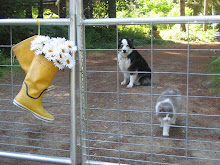
These are the boots that have hung on our gate since we settled on the name Mucky Boots Farm for this place.

They aren't even farmer's boots - they're sailor's boots - but they're what we had at the time. They were bright yellow and welcoming, and looked great with the fake daisies we filled them with.

Now, after more than a year of all kinds of weather they are faded to a sickly yellow-beige, they're cracking, and every time it rains the weight of the water filling up the boots rips them a little more from the cord we hung them from.

Time for a farm-gate-boot makeover.

To that end, I have been looking for some boots with attitude at discount and thrift stores, and haven't found anything with enough personality. After all, the boots on the gate are the first thing visitors see and the easiest way for them to identify our property, so Plain Jane green or black rubber boots won't quite do.

Then, probably in response to the recent bad weather, a local store got in a new order of rubber boots, so we went to check them out. And there I was with Kim, who was buying serious waterproofed, insulated, rugged-soled chicken-mucking rubber boots, and what was I buying?

These.


Welcome to Mucky Boots Farm!

Friday, November 26, 2010

Melt


We've had a week of not weather, but Weather. Snow. More snow. Freezing temperatures. Still more snow. Even colder temperatures. Okay, we're wimps, but still - it has been an interesting week.

Overnight the snow turned to rain and today it's about 5C, which means the melt is on. Sitting inside drinking tea, I was puzzled by the loud, muffled whumps coming from outside, until I realized the trees were all shedding their heavy, wet snow burdens. I could feel their relief. And when I went out to the porch to have a closer look, the sun coming through the trees dazzled my eyes. I felt like a bat, or a vampire. That's what happens when you spend a winter on Vancouver Island - you forget what the sun looks like...

Tuesday, November 23, 2010

Frozen


Okay, I know we southern-Vancouver-Islanders don't have much to complain about in the weather department...but it's cold!

Normal temperatures here through the winter are about 5 degrees Celsius (which translates into 40 degrees Fahrenheit), but last night it got down to -10. Brrr! So with the snow we've had, and now the cold, the weather is all anyone wants to talk about. Me included.

Kim was worried about the chickens, of course, so two days ago we put a little heater in the coop. This morning when we went to check on the flock the temperature was a couple of degrees below freezing, which seemed quite manageable for them - although all their water was frozen. We still haven't figured that one out -today Kim has put the heat mats from the greenhouse underneath the fountains, to see if that will make enough of a difference.

That wasn't all the water that was frozen this morning - once I had filled the coffee pot (thank goodness - I can't imagine how we would have dealt with an emergency if there hadn't been coffee) the water from the tap slowed to a dribble and then disappeared altogether.

Based on our horrible experience our first winter here, our first thought was frozen or cracked pipes in the pumphouse, but we have a heater there that's supposed to kick in when the temperature reaches freezing. We headed out, expecting to see water everywhere, but it was dry. The only problem seemed to be that the pressure tank was empty - so why wasn't it filling?

We cranked up the heater in case something to do with the pump itself was just too cold to work, and sure enough, in just a few minutes we had water again. Phew.

Funny how we take things for granted. Doing without water for all of 10 minutes has been enough to make toilets flushing and water flowing from the tap seem like the best thing ever.

Monday, November 22, 2010

A messy chicken is a junco's best friend


Who knew that when we hung the disco dance streamers in the chicken yard, we were inviting the whole neighbourhood over for a party?

The chicken yard is turning into Grand Central Station for the local overwintering birds, especially the Dark-Eyed Juncos. I don't know where they normally hang out, but right now they're thick in all the nearby trees, they're swooping in and out of the coop, and they have even been seen having a leisurely meal in the chicken tractor in the orchard.

Why such an explosion? Because our chickens are messy, messy eaters. They flick their feed left and right searching for the best bits, and in the process an awful lot of feed ends up on the ground - fair game for a hungry junco.

At some point we might have to do something about it, but right now we're just enjoying the party.

(Image from here.)

Saturday, November 20, 2010

Wonderland


We don't get much snow here on southern Vancouver Island, and when we do the normal functioning of society tends to grind to a halt. Part of that is because the snow is usually wet and the temperature right around freezing, so the weight of a car turns it instantly to ice. But I like to think that the other part is that it's just so gosh-darned beautiful when it snows.

True to the weather forecast that has been circulating for a few days, it snowed last night - about eight inches where we are (which means maybe two or three everywhere else...). We woke this morning to trees and fence lines coated in white.


Kim has kept the chickens in the chicken yard today, where the thick overhanging evergreen branches have kept most of the snow from reaching the ground.


I think Pee Wee is quite proud of how nicely the snow sets off the red of his comb and wattles...


...or maybe he is just wondering what happened to the disco dance party.

Thursday, November 18, 2010

Berries


We are having (another) grey, drizzly day here at Mucky Boots - with a bit of excitement this morning when the cold rain turned to slushy snow. Frankie acquired a white coat, the chickens were very perplexed, and Kim and I got cold noses and fingers working outside.

There was an extra bit of excitement when we looked down the lane from the coop to the house and saw flashing lights and two men in work gear with a chain saw, apparently cutting down one of our trees. We flew down the path waving our arms and hollering - and it turned out they were from the hydro company and they weren't cutting down a tree, they were drilling a hole in our power pole to check for rot.

The nice thing about the incident (other than learning our pole is rot-free) was that my attention was caught by some beautiful red berries growing in that part of the garden. The holly berries are a show-stopper, of course, but also glowing red in the greyness of the day were these berries on the winged euonymous.


Those of you who have been reading this blog for a while know I have been trying to rehabilitate my feelings about our winged euonymous bushes. They look too much like alien stick insects for my comfort.


But this fall's display of colour started to change my mind, and now these tiny red berries have convinced me it's time to get over my hangups and appreciate these bushes for real.

Tuesday, November 16, 2010

Sweet, odd Hector


Hector is the youngest of our 19 chickens, and the cockerel counterpart to our two Black Australorp hens Alice and Gertie. As the youngest of the lot he has been on the bottom rung of the pecking order - actually, if there was a basement to the pecking order that's where he would be.

Everyone chases Hector. The older Buff Orpington hens chase him. The younger hens chase him. The big boss Pee Wee chases him. The remaining cockerel on Death Row chases him. Even Alice and Gertie chase him. It's very hard to get a good picture of Hector because he's always running.


We're a bit puzzled by all this, because after all, Hector is a cockerel, and he is growing up, and he should be starting to channel his inner-rooster. So far nothing. Once in a while he will try standing up to Alice and Gertie (who are just above him in the pecking order) but he always backs down and runs away.

We're also puzzled (and intrigued and utterly charmed) by the other part of Hectors's personality: he is very much his own little creature. When the rest of the flock is voraciously grazing in the orchard he can be found swinging on the roost in the chicken yard, happy as can be. And on top of it all, Hector has yet to make a sound. Well, he does make sweet cooing noises when he's settling in for the night (as do Alice and Gertie - it must be an Australorp thing), but he has never uttered anything at all resembling even a baby cock-a-doodle-do.

All in all, he's an odd, sweet duck. I mean chicken. We love him.

We felt awful the other day when we put him in the chicken yard with Pee Wee, the king of the roost. Pee Wee is relatively gentle as big roosters go, and he and Hector had shared a yard before. We put them together because Kim is trying to find ways of managing their feed: non-laying pullets and roosters shouldn't be given the calcium-enriched feed laying hens get, because the extra calcium is hard on their kidneys. But this time Pee Wee pounced on Hector, and without enough room for running away Hector flew into the fence a couple of times and then ran to a corner where he buried his head into the dirt as far as it would go. What a great defensive tactic. We rushed to his rescue, of course, and will never put the two of them together again. But it felt like...well it felt like the last episode of Glee, where Kurt kept getting shoved into the lockers by the football team.

So we started to wonder. Maybe Hector, our sweet gentle Hector, is gay. Plus he's mute.

Our darling Hector is a gay, mute chicken.

Sunday, November 14, 2010

Finally done

It's done. The workshop is finally done. Well...almost.

We have been working on it for a year. Last November we started with this...


...a sturdy, well-built but unfinished workshop. It was definitely an asset when we looked at the property, but a bit of an eyesore. So last November we began with the siding and managed to get it done before the fall rains began in earnest. It involved some tricky cutting, a special heavy-duty nail gun rented from Rona, and lots of swearing as we worked really hard to maneuver the heavy, floppy panels into place. It was the hardest thing we've done at Mucky Boots - so far.


This summer we painted the siding and the doors, installed the trim at the corners of the building and around the doors and windows, and got started with the cedar shakes on the gable ends before - with the fascia, gutters, soffits and shakes still left to do - we plain ran out of steam.

Enter the professionals. $1500 and 3 days later, this was our workshop.


Doesn't it look charming? As our neighbours say, it looks like a bungalow. We think we might move in. Look at those lovely gable ends. Admire the red doors. And the gutters - we have gutters! No more rain dripping down our necks as we fumble with the key to unlock the door.


We didn't install the window trim quite correctly and there are a few small things left to do: the door needs a paint touch-up and the exterior lights need to be installed. But we're happy and relieved to be able to cross this big job off our mile-long to-do list.

You may feel happy for us, but you may also want to spare a thought for the poor rats, mice and squirrels who have been taking advantage of the fact the workshop had no soffits, and making their snug, warm homes in the attic of the workshop. They're homeless now.

Saturday, November 13, 2010

Second string


Are you tired of posts about chickens and eggs yet?

We have been busy this week with extra rehearsals for a concert tonight by the local orchestra and choir we sing and play in. Plus we've had a crew in finishing up our workshop for us (more on this later). But everything ground to a halt when we realized our original pullets had laid their first eggs.

We've had eggs for a number of weeks now, but they've come from the slightly older flock we got from Ev. Our original birds, the ones we raised from day-old chicks, have been showing a lot of interest in what the big girls have been up to in the nest boxes: they've been cruising in and out of the coop to see the laying process in person, and have been practising the clucks and calls that seem to be a necessary part of the whole process.

And then two days ago Kim found the first egg in the younger flock's enclosure in the coop. Celebration!

The first eggs that a pullet lays are often smaller than normal, or oddly shaped. In the photo above, the top egg is one laid by an experienced pullet, while the bottom two (one long and skinny, one very small) were the second and third eggs laid by the first-timers. They are the sweetest eggs ever.

We're currently averaging seven eggs a day from the nine older pullets, so when the seven younger birds are up to full steam we're expecting about a dozen eggs a day. Consequently Kim has plunged head first into the sales side of the equation. Our friend Margaret, who still works at the school we left to become farmers, has been our guardian angel: she volunteered to take on the task of distributing our eggs at the school and collecting the money. Kim goes into Victoria to the school every week for a band rehearsal, so this week she brought in the first 3 dozen for Margaret to sell - and they were snapped up before she could even put the word out. And Margaret had the wonderful idea to include stories about the Mucky Boots Farm chickens in each carton, so that's what we're doing.


I have to say, nobody would ever get rich selling eggs. Once the chickies are up to full production they should be covering their costs (organic feed is not cheap), without much profit to speak of. I was worried Kim might be discouraged by this, but she is content looking at it as a hobby paying for itself, with fresh, high-quality eggs for us to eat as a bonus.

But it has given us even more respect for anyone who tries to make a living producing food for the rest of us.

Tuesday, November 9, 2010

Gender and race in the chicken yard


As chickens have become a fixture at Mucky Boots, I have become aware of some aspects of the whole business that make me, a generally socially progressive kind of person, uncomfortable.

Take race, for example. I know chickens are not people, and I shouldn't project hundreds of years of oppression of black people onto our birds, but when we're putting the chickens to bed at night, part of me feels quite horrified that the black Australorps go in one enclosure and the yellow Orpingtons go in another. Not to mention it's the smallest enclosure. My rational brain says there are good reasons for it: they needed to be separate because they are lowest on the totem pole, not because of their colour but because they are the youngest. And we put them where we do because are they are the smallest subgroup, so logically they should go in the smallest space. But that's my rational brain. The rest of me feels that a colour-segregated chicken coop is just plain wrong.

And then there's gender. We call our pullets and laying hens "girls." For someone who wore a button all through my university days that said "I'm not a girl" and insisted on being called a woman instead, I was shocked to hear myself referring to these birds as "girls." What should I call them? Chicken women?

On top of that, I realized that only four of our sixteen female chickens have names (Marilyn for the blondest of the Orpingtons, Eva for the first hen to lay, and Alice and Gertie for the inseparable Australorps), and even then the names are more theoretical than practical, because we can't really tell them apart (beyond the black versus yellow, of course) unless we get close enough to decipher the codes on their leg bands. On the other hand, every one of the male chickens have (or had...) names: Pee Wee, Big Boy, Hector, Red Toe, Fluffy Butt and No Name (which really was his name). So the male chickens are recognized as individual and special, but the female birds don't rise above an indistinguishable mass. Discrimination!

Although I suppose the reverse discrimination of "if you're female you get to live out your life and if you're male the chances are pretty high you'll wind up in the freezer" probably outweighs any bad feelings the hens might have about being called a girl...

Sunday, November 7, 2010

The last of the fall


It looks like the glorious, crisp sunny days we enjoyed at the start of the month are on their way out, replaced by the rain that will be with us through most of the winter. So before the the fall colour is gone for good - or at least until next year - here is some of the beauty still to be found.


There's something about the colours of decay that fascinate me, whether it's corroding factory pipes or crumbling plaster walls or the plants in my garden. I think these mottled, decomposing leaves are even more beautiful than their fresh, spring-green incarnations.


Friday, November 5, 2010

Chicken curry and eggs


First, an update on the trip to the slaughterhouse. By the time we went back to Island Farms on Tuesday afternoon to pick up the three gutted and plucked roosters, we were doing pretty well at feeling philosophical, if not actually positive, about the whole thing. But when we got home and opened up the cardboard box and saw three scrawny, long-legged carcasses we felt awful all over again. The boys have gone into the freezer for the time being - maybe they'll make a good chicken curry dish some day.

Big Boy, the remaining rooster from the original flock we raised from day-old chicks, is now living on borrowed time. We had planned to keep him for breeding, since he was the biggest, but he's turning into something of a pain. We have to keep him separate from Pee Wee, the enormous rooster that came with Ev's flock, since the two of them have hated each other on sight. This poses some logistical issues. But the real problem is how brutal he is with the hens when he tries to mate with them. As a result, even the hens that have been raised with him run away when he gets close, and are noticeable jumpy and stressed when they are in the same enclosure with him. The only bird that gets along with him is Hector, our sweet boy Hector. In contrast, Pee Wee gets the mating business over with much more smoothly, and all hens from both flocks are very comfortable with him. We called Ev and ran it by her, and she said very emphatically that Big Boy shouldn't be used for breeding, because that roughness is not something you want to breed for.

So we put Big Boy in the orchard, where he could be away from the other birds but still be able to graze on all the grass and bugs - which led to a renaming of the orchard from "The Cloister" to "Death Row." Kim is still weighing the options, but it looks like Big Boy may be joining his brothers in our freezer...

On a much happier note, our girls have been laying up a storm. All nine of the pullets we got from Ev are now laying, and although we were told to expect about six eggs a day from them, we've had eight on a few occasions. The four nest boxes are so often full...


...that Kim has now added a second tier of three boxes beneath the existing ones. And it seems as if the two Australorp pullets and our original five Buff Orpingtons might start laying soon: they are showing a lot of interest in the nest boxes, and are practicing their "I'm laying an egg" chicken song.

Tuesday, November 2, 2010

Goodbye Red Toe


This morning an era ended at Mucky Boots. This morning we loaded Red Toe, Fluffy Butt and No Name into a crate and took them to Island Farms, the local chicken slaughterhouse.

We said goodbye and thanked them for being good roosters (overlooking Red Toe's persistent attacks on our feet). Then we climbed back in the truck and drove home for breakfast. This afternoon we'll return to the slaughterhouse, hand over $12, and pick up three gutted, plucked and bagged chickens.

It was busy at Island Farms this morning - it must be the time of year people slaughter the meat birds they've been raising all summer. Trucks pulled in and out of the parking lot in the early morning fog, leaving their crates of birds in the orderly configurations dictated by the employees, each crate carefully tagged with the owner's information. A white-coated and hard-hatted inspector cruised through the stacks with her clipboard, looking for signs of illness among the chickens. When we told her it was our first time she smiled and asked how it was going so far.

Some people brought a single crate, like us. Others brought flats and flats of birds. Once their birds were unloaded and tagged people stood around the parking lot with their Tim Horton's coffee cups and chatted - just another day. But for us it felt anything but regular. Kim was a bit teary. I was trying to be philosophical. But there's only so far philosophical can take you.

This is where the rubber hits the road. All those chickens I've eaten in my life have been their own little creatures. Most raised in less than humane conditions. But all I've seen are the neat rows of wings in the styrofoam trays. Later today I'll hold a butchered chicken in a plastic bag and it won't be an anonymous bird. It will be the one who pecked me bloody more than once, or the one whose fluffy tail feathers shook when he stomped his feet in a little chicken dance, or the one who minded his own business so successfully he didn't even get a name. How can I possibly put that bird in the oven for dinner?

Growing carrots is one thing. I am learning that raising chickens for meat is a completely different matter.
Related Posts Plugin for WordPress, Blogger...