Monday, February 13, 2012

Almost spring


Today it felt like spring. I know it's not really spring, and there are likely to be many more rainy, grey days and maybe even some snow. But for today I can imagine that there is nothing but balmy days and sunshine ahead.

There were the usual signs that winter is on its way out. Snowdrops and aconite are busting out all over...


...and when I cleaned up last year's sedum (aren't the dead flower heads gorgeous?)...


...there were lovely new buds waiting to be uncovered.


Here's another sign that spring is on its way: for the next few weeks the pond is in the fleeting state between covered with ice and snow, and filled with emerging grasses and water plants, which means there are newly visible treasures just waiting to be discovered.


Look closer: can you see? This is the secret gathering place for Frankie's balls that go bouncing off into the water.


In the greenhouse the first leek seedlings are making an appearance...


...and Kim has installed this year's new and improved shelves: cedar, and they smell heavenly.


All of us enjoyed the sunshine today - the chickens...


...and the guitar-playing frog.


But here's the most definitive sign that spring is near: the appearance of Miss Comfort Queen herself, finally emerging from her winter-long hibernation near the wood stove.


Happy Almost-Spring, everyone.

Wednesday, February 8, 2012

Quiet


Our power went out this morning, which came as a real surprise. We live in the country, with all the power lines strung from pole to pole rather than being buried safely underground, so we often lose the power in the winter, what with wind storms, freezing rain, or the occasional dump of wet snow.

But just this week I emptied the jugs of drinking water on the counter that had been sitting there since the last wind storm, thinking we'd got off easily this winter: one very brief power outage, and we weren't even home when it happened. Somehow, semi-subconsciously, I thought the power failure season was done.

According to BC Hydro the reason for this outage was a tree down across a power line. I'm wondering if it wasn't BC Hydro itself that was responsible: they've been replacing a number of the power poles in the neighbourhood, and at the same time taking down a whole bunch of the trees that would be most likely to take out a line if they fell. Maybe a tree fell in a different direction than planned, or the crew lost control of a big branch as it came down.

In any case, we spent the morning in the dark. Kim went off to do some errands, so I was on my own - just me, my day's plans thrown awry because they all required electricity, looking for things to do in the murky half-light of a cloudy morning. I found a few jobs I could do (really exciting things like filing), but mostly what I discovered was the quiet.

No radio in the background. No hum of the fridge or whoosh of the dishwasher. No click of fingers on a computer keyboard. No phone ringing. Just deep, heavy, calming quiet. As I sorted through bills and bank statements I became aware of the sound of my own breathing and I was amazed at how noteworthy that was. My breath travels around with me every day - why don't I notice its sound more often? Then Frankie came into the room in search of a comfortable spot to snooze, and the sound of his snoring joined my breath in a companionable, peaceful counterpoint.

How did my life get so noisy? Noise was something I took for granted in my old life, but in my new, improved Mucky Boots life I thought I had a different kind of balance. But somehow the background chatter and hum has snuck up and overtaken the quiet again, so that the sound of my own breath comes as a surprise.

And maybe it's more than just noise. Maybe all that background electromagnetic radiation from computers and clock radios and wireless modems and cordless phones creates an inaudible sort of racket that I don't notice until the power goes out and everything goes dark. Which might help explain how simple and peaceful and calm things felt around here this morning.

I'm beginning to cast a new eye on the main breaker switch on our fuse box. Maybe some homemade power outages are in order.

Friday, February 3, 2012

Sleepover


We love having visitors at Mucky Boots, especially ones who bring their own toothbrush. Because we live an hour away from our friends in Victoria, and because that hour's drive involves the notorious Malahat Highway, our guests often feel they need to leave early in to make it back over the Malahat before it gets too dark (at least that's the reason they give us...) So a visit that's also a sleepover is lots of fun because nobody's watching the clock, or watching how many glasses of wine they've had - we're all just enjoying ourselves and each other's company.

Our friend Donna has come for a visit today, and aren't we tickled pink! For all kinds of reasons: Donna is a wonderful friend, has a laugh that fills the room and a heart that's even bigger, and she is a superb musician who always remembers to bring her viola. So this is what I got to listen to as I puttered in the kitchen making supper.


Lucky me!

We have a lovely guest room just for these occasions, with the world's second most comfortable bed, a lovely view of the garden, beautiful paintings on the wall. Fluffy towels in the bathroom.


Doesn't it make you want to come to stay?

Thursday, February 2, 2012

And the winners are...


...Rae from Blissful in the Boonies and Ann from Shim Farm. [You can thank the random number generator at www.random.org!]

Please send me an email at mstanford@shaw.ca with your mailing addresses, and the soap will be on its way to you lickety-split.

I wish there was enough soap for me to send some to everyone. I guess I better get making some more...

Sunday, January 29, 2012

300


This is my 300th post. How did that happen?

I started blogging in October 2009, about 8 months after Kim and I moved here to Mucky Boots, and about 3 months after we quit our teaching jobs. I began writing for my family, to share with them my excitement about this adventure. But somehow, somewhere along the way, other people began to find their way here and I became part of a bigger community. We are gardeners, and chefs, and teachers. We are artists and musicians. Some of us are activists on a small or large stage, some of us work to make safe and loving homes for our families. We grow tomatoes and flowers, knit sweaters and mittens, build garden beds and communities. We come from many places and lead different kinds of lives, but we are linked by our shared excitement over the ritual of starting seeds in the spring, and our satisfaction in finding a way to use scrap lumber to build a functional gate, and our pride at the taste of food raised or grown by our own hands. By our awe at the beauty of the world around us, and the rhythms and gifts of nature.

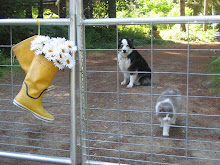
So, dear readers, to celebrate 300 posts and to thank you for sharing this adventure with me, I want to imagine a garden party here at Mucky Boots, with friends and family come from far and wide to visit - dressed in their favourite pair of boots.

Post a comment telling me about the boots you would wear to the celebration. These could be real or imagined: the red cowboy boots you had as a child, the hip waders you've always dreamed of, the steel-toed boots you use for work, or maybe the rubber boots that see you safely through the muckier parts of your life. In exchange, I'll draw two names from all the comments, and the winners will receive a selection of Mucky Boots All-Vegetable Handmade Soaps.

Whether or not you leave a comment, I want you to know how grateful I am that you take the time to visit. You not only share your kindness and wisdom and experience with me through your comments and your own blogs, you give me a reason to think more deeply about my days. My heartfelt thanks to you all.

Photo from here.

Thursday, January 26, 2012

Soap


I have been waiting to write this post since August, when the whole project got started. The problem was, these were Christmas presents I was making, and my family and friends read this blog. So I had to wait, and now, finally, all the Christmas presents have been delivered and received - all except the package for my friends Jean and Jim, who are just going to have to act surprised when I finally see them on Saturday.

Soap, I'm talking soap! Yes, I now can grow vegetables, bake a loaf of bread and make soap.

I knew I wanted to make all-vegetable soap - there's something not so appealing to me about washing my body with animal fat. So I started with instructions from the Down to Earth blog and made my first batch with olive oil, organic coconut oil, rice bran oil and lye - simple, basic soap. And it was easy! So easy and so satisfying that more batches followed quickly, one with just olive and coconut oils, and then one where I started experimenting with adding essential oils. Soon the dining room table was covered with curing bars of soap and my sweetheart was starting to politely wonder about a possible new addiction.

She may have had a point, because even after all the Christmas presents were distributed, we're still left with what is probably a lifetime supply. But I'm not complaining. And I'm already itching for an excuse to start up all over again.

The basic procedure for cold processed soap is to mix lye and water, which then becomes very hot and gives off fumes. While you're waiting for it to cool down you gently heat the oils you want to use on the stove. When the cooling lye reaches the temperature of the heating oils (about 100 degrees) they are combined, then mixed until they reach "trace", which means it's about the consistency of pudding. Then any botanical ingredients or essential oils are added, the soap is poured into a mold, swaddled in towels and left to cool for 24 hours. Then it's removed from the mold, cut into bars and left to cure on a rack for about 6 weeks.

I think I made about ten batches in all, which hardly makes me an expert. But here are a few tips for you, in case you'd like to give it a try yourself.

Tip #1: Don't fool yourself that you're only going to make one batch. Take the time to source out bulk supplies, otherwise you'll end up spending more money than you need to.

Tip #2: Be sensible but don't be afraid. Some soap-making instructions I read would have had me dress up in hazmat gear because the lye is so caustic. I took reasonable precautions, like mixing the water and lye outside because of the fumes, covering countertops with old towels and making sure the animals were not underfoot, and I had no problems.

Tip #3: You don't need separate equipment for soap-making. Again, some instructions I read directed me to have pots, bowls, spoons and mixers devoted solely to soap making. I don't think this is necessary, provided you wash everything thoroughly when you're done. My only exception was the candy thermometer I used, which was constructed in such a way that I couldn't clean out the nicks and crannies as well as I would have liked. So it won't get used for regular cooking anymore.

Tip #4: Invest in a hand blender. It can take a lot of painful mixing to reach trace, if you're doing it by hand. With a hand blender the whole process is not only easier, it's much quicker. I used an old plastic hand blender that had been deformed by being immersed in hot soups. Otherwise, I would have looked for a used one at a thrift store or garage sale.

Tip #5: Don't spend money on molds unless you're thinking of going into commercial production. I spent some time on soap making supply websites, and it would have been really easy to rack up a big bill buying molds. But things you have around the house will work just as well. I used empty milk cartons for a few batches, silicon muffin tins for another, and then I picked up some 2-inch high drawer organizer trays at the dollar store that I used for the rest. Whatever you use has to be stiff enough to keep its shape when you pour in the soap, leak proof, and able to withstand fairly high temperatures.

Tip #6: Whatever you use for a mold, grease it well! Enough said.

Tip #7: If you start looking on the internet for recipes using essential oils to add a scent to your soap, you won't believe how much you're supposed to use, but it's true. I think it must be because the high heat that is generated by the saponification process breaks down the essential oil so it becomes far less potent.

Tip #8: Cover the exposed surface of freshly made soap with plastic. I learned this when my first batch developed a thin layer of white powder on the exposed surface. It's called "ash" and it doesn't affect the performance of the soap, just the look. You can shave it off with a vegetable peeler, or try to prevent it by using plastic.

Tip #9: Get started early. Soap needs at least 6 weeks of curing time, during which the saponification process continues and the soap hardens. If you try to use your soap too early it will not only not last as long, it could still be caustic.

Tip #10: Save the scrap ends and bits and pieces. I have a baggie full, and plan to use the grated soap in this hand scrub, to keep me looking presentable through the gardening season.


I'm trying really hard not to get too carried away, but now I'm really curious about making my own lye from wood ash, instead of buying it in pellets at the hardware store. After all, that's what Laura would do...

Saturday, January 21, 2012

Winter


We have been having a strange winter (although I hesitate to use that word since none of the winters we have had here at Mucky Boots have fit the usual pattern): more sun than usual, and colder than usual. And almost no snow, which I attributed to the fact Kim and I finally got snow tires for our car.

And then, this week - snow!


It came in a few acts: four inches of soft, beautiful powder one day (unlike our usual sodden, heavy, wet snow) another eight or so two days later, then a brief flirtation with freezing rain that laid down a slick coating on top of it all. And now it's dissolving in a steady rain that is making a muddy, sloppy mess out of everything.

The best part of the week was the lifting from my shoulders of the huge weight of worry (and before you worry, please remember that worrying about anything and everything is a specialty of mine) when I realized what an enormous difference our new snow tires make. That horrible hill we need to drive up in order to get to the main road that has been the scene of more than one slow-motion icy ballet as we struggled up only to slide back down again? Hah! No problem: I drove straight up easy as pie. The drifts in the driveway that would have had us digging and pushing and swearing and pushing again? No problem: I just drove right through them.

And then there was the joy of watching Frankie in the snow. This may be his twelfth winter, but any sign of senior doggy dignity gets lost the instant his paws touch snow. It almost makes me wish for more snow.

Almost.

Friday, January 13, 2012

Fourth year blues


Last week should have been a happy week, sort of like Christmas come again. Last week the catalogues from three seed companies arrived in the mail. This should have launched an orgy of reading and planning next year's garden, the equivalent of my seven-year-old self poring over the Sears Christmas catalogue, reading every description of every toy, wondering how I would ever choose only one or two. But it didn't.

I flipped through the catalogues, I put sticky notes on a few pages, I made a note or two in my garden book, but my heart wasn't in it. Onions? Oh, I'll just stick with the usual Red Wing and Copra varieties. Tomatoes? I'll just plant what I planted last year. Peas? Same old, same old.

This will be the fourth time I plan a vegetable garden. I should get weeks of planning pleasure out of those catalogues. But what I got instead was The Fourth Year Blues. What was wrong with me? How could I still have been so excited last year, and this year be in the doldrums?

Last year I planned my garden just after reading Carol Deppe's book The Resilient Gardener, and was excited about winter squash, and getting protein from the garden, and improving potato yields. I was going to try growing broccoli, Brussels sprouts, quinoa and garbanzo beans for the first time. My garden was going to be my laboratory, full of interesting experiments. This year? Not so much.

Maybe it's just that the whole business of growing food, something that was so new and exciting, so life changing, has simply become more routine, more regular, more a part of the daily background. Maybe it's that my wish to tighten our gardening budget has left me feeling too constrained. Or maybe my natural tendency to organize and routinize has left no room for play.

In any case, I decided what I needed was an injection of whimsy. Something whose appeal has nothing to do with food values, or self-sufficiency, or anything practical at all. Yes, I would continue to grow the reliable standbys that have seen me through the first three years. But I would flip once more through the catalogues looking for something that would inspire me with its quirkiness, its beauty, its impracticality.

And here's what I found: pink popcorn and brilliant red corn poppies. One is for play, for a silly pink colour and a bowlful of fluffy kernels. And one is for beauty of a natural and random sort, the kind that springs up when seeds are simply scattered, rather than being planted one by one at a prescribed depth in rows of orderly pots in a temperature-controlled greenhouse according to a predetermined timeline.

That's what I'm going to grow this year: play and random beauty. I'm looking forward to the harvest.

Image from here.

Sunday, January 8, 2012

Big


I have come across a lot of blog posts about big eggs. The simple fact that chickens lay eggs is miraculous enough, but when a hen lays a really big one, it's post-worthy for even an experienced chicken farmer.

I did it myself, back in the early days. But lately I've considered myself a bit too worldly, a tad too experienced, a smidge too cosmopolitan and sophisticated to get all excited about a big egg.

Until today. Until this really, really, really big egg.

Large eggs should weigh at least 56 grams, extra-large at least 64, and jumbo at least 70. This egg weighed 96 grams.

Here's the proof.


Holy smokes, that's a big egg.

Thursday, January 5, 2012

Leftover


I feel a little silly about this post, because I know many of you are experts at making good use of the food that comes into your home. But this isn't something I've been especially good at. Things changed a bit when we moved to Mucky Boots and started growing our own vegetables: my mindset started to shift from "What's the recipe, go buy the ingredients" to "What's ready in the garden and how can I make use of it." But the fridge was still a place where leftovers found their own way to the back corners and died a slow, smelly death.

I am determined that this year, that's going to change. Part of it is trying to make better use of every food dollar. But the bigger part is out of respect for the food itself and the people who produced it, and out of recognition for how lucky we are to have it when so many in the world don't have enough. No, I'm not about to start packaging up my unwanted kale to send to the starving children in Africa. But I think I can do better with what we have.

Please forgive me if this all sounds like Leftovers 101 - but that's where I am: at the beginning. And the first challenge of the year was what to do with all the remains of our Christmas dinner. There were a lot of them, since Kim and I were on our own this year. Some things were obvious: we did a couple of days of reheated encore dinners, I made a batch of stock with the carcass of the turkey, and then a great turkey and vegetable soup. But there was still an awful lot of turkey, potatoes, gravy, squash and cranberry sauce left when New Year's rolled around.

Let me try to contain my glee as I tell you what I did.


Inspiration #1: Turkey croquettes. I took the last 4 cups of turkey meat, the last 2 cups of mashed potatoes and the last cup or so of gravy and whizzed them in the food processor until I got a pretty smooth mix. I added some green onions and a bit more seasoning, then formed it into croquettes and did a rice flour/beaten egg/smashed cornflake coating. 30 minutes or so in the oven and they were done, and didn't they go nicely with the leftover cranberry sauce! The best part is that I now have about 2 dozen of them in the freezer, for quick and easy dinners in the future.

Inspiration #2: Squash muffins. I have a killer gluten-free pumpkin muffin recipe that I make regularly, in a double batch so half can go in the freezer. So it occurred to me to replace the pumpkin puree with the leftover acorn squash, mashed into oblivion. I was worried about the seasonings: the maple syrup and cinnamon I had flavoured the squash with for Christmas dinner would go nicely in muffins, but I wasn't so sure about the thyme. But I tried it anyway, added a bit of streusel topping to compensate, and they were fabulous. More distinguishable from the pumpkin version than I had anticipated - a bit denser, sweeter, more squashy. Yum.

Like I said, Leftovers 101. But with the exception of about half-a-cup of cranberry sauce still lurking in the fridge, every bit of our Christmas dinner has been used.

Just call me Suzy Homemaker.

Wednesday, January 4, 2012

Back to normal


Our heartfelt thanks for your comments and emails about William. Most of you have never met us, or William, or been to Mucky Boots - it is an amazing thing to me that such caring and support can come across the ether.

We are feeling more peaceful about William's death, with just the occasional stumble to make us pause: vacuuming up the last of Williams' hair from the carpet, washing and putting away his water bowl, opening the back door and not realizing we were expecting to see him until we are surprised when he's not there. Petunia was out of sorts for a few days, but she knows how to demand a snuggle when she needs one. Mostly she, like us, is spending the bulk of these rainy, cold days in front of the wood stove. We are finding our way back to normal.

Friday, December 30, 2011

Goodbye William


William died yesterday - he was hit by a car. He was too old, and the damage was too great, for him to survive, so we had him put to sleep late last night. After a terrible day in which he managed to drag himself home through the rain on two legs, he ended his life peacefully, wrapped in warm blankets and surrounded by love.

He was 16, and had gone through more lives than two cats put together. When he was just a kitten he was found abandoned in an empty apartment in Toronto with his sister Arbus, and when they were about 6 months old they were adopted by Kim. Maybe memories of those early days trapped in the apartment stayed with him, because he much preferred an outdoor life - at his prime he would only come home to eat, spending his days roaming the neighbourhood and dining at a few homes other than ours. When we still lived in Ontario he loved to go camping with Kim at her property north of Toronto - he would sleep in the tent with her at night, and go canoeing with her during the day.

William was a charmer, a character, and a very handsome cat - he looked just like Sylvester from the Bugs Bunny cartoons, only grey and white instead of black and white. His long, silky fur was gorgeous, but a problem for a wild outdoor roamer like him. We always knew where to find him in the house because he would leave a trail of debris behind him -all the sticks, leaves and burrs he dragged in with him would gradually be deposited on floors, couches, counters and beds.


His closest call came about eight years ago, when a raccoon chomped out a good portion of his throat. As he recuperated he had a tube to drain the wound running right through his neck, so he looked like a very handsome and furry Frankenstein. We tried keeping him in after that, but he was miserable being confined, and so we decided to let him lead the life he wanted.


He started to slow down in the last year or two, and began spending his days on the rocking chair in the verandah and his nights in his special bed away from the pestering attention of Petunia.

And now we imagine him reunited with Arbus, young and strong, with all his teeth again, and fur without a single mat, roaming the bush in search of more adventures. Thank you, William, for making it home last night so we we had a chance to say goodbye. You were a good cat and we will miss you.

Sunday, December 25, 2011

Merry Christmas from Mucky Boots


Frankie is one happy dog today. His human grandparents don't only know what makes my heart sing (new ergonomic gardening hand tools in lime green so I don't lose them) and Kim's (a new book full of colour photos on guitars and guitar makers). They also remember the four-legged members of the family. And so Frankie is the ecstatic recipient of a knotted rope toy and a fabulous new B-A-L-L. What a lucky boy.

Saturday, December 24, 2011

Joy


After a run of bright, sunny and cold days, it looks like we're in for a warmer, foggy, wet Christmas. Which could just about match my mood (I am once again prevented from participating in a family Christmas by my don't-you-dare-get-on-a-plane-sinuses) were it not for my sweetie, who is full of enough Christmas spirit for the both of us. Thanks to Kim, we have fairy lights twinkling on the verandah, a beautifully decorated Christmas tree in the living room, and bouquets and garlands of salal, holly and cedar adorning the entire house - not to mention a turkey in the fridge waiting to go into its brine bath sometime today.

If I could name only one gift Kim gives me year round (and there are so many) it would be the gift of joy - her easy laughter and joyful heart blow clean, fresh, cedar-scented air through the thickest fog of sadness or worry. She finds the humour in any situation, can cheer up the glummest person with her funny voices and chicken imitations, and has magically turned what could have been a lonely Christmas into a magically special time for two.

Who needs a better gift than that?

Happy Holidays, everyone. I wish you joy in your hearts every day of the year.

Monday, December 19, 2011

Line in the sand


Well, not sand exactly. More like dirt. And the line goes clear from one side of our long, skinny property to the other, cutting it in half. A half for me. And a half for the chickens.

The problem is that Gump and his flock of teenage pullets have been making themselves at home in the front half of the property, where the house and all the perennial gardens are, and they are making a mess. There's the issue of poop everywhere, which is bad enough, but the thing that is making me tear out my hair is the damage the chickens are doing to all my perennial beds.

I have a love/hate relationship with those beds. Actually, forget the love part of that equation: it's more like a lukewarm regard. We inherited them from the previous owners, and there are a few problems with them. There is way too much square footage. The beds are infested with mint and creeping bellflower. And practically everything in the beds that's supposed to be there is of the grow-in-the-spring-cut-down-in-the-fall variety - in other words, a perennial. There are very few shrubs or trees, which means the beds are splendiferous in the spring and summer, and a desolate wasteland in the winter.

But the biggest problem is they don't feel like mine. Unlike the vegetable garden and greenhouse, they aren't a source of joy - they're a place where I feel the pinch of my perfectionism most acutely, where I feel smothered in responsibility. These beds were someone else's dream - I didn't design the beds, or choose the plants. I'm just responsible for making sure they aren't overtaken completely. So I was floored when my friend Elisabeth, a passionate gardener herself, asked if I got pleasure from that part of my garden. All I could do was gape at her like an idiot while my brain tried furiously to compute some sense from that statement. Pleasure? Seriously?

I'm working on it. I've converted small portions back to what we like to call lawn (which really means an easy-to-care-for mix of grass, moss and mow-able weeds). Kim and I bought out the fall sale at our local garden centre and planted a small army of shrubs this year to try to lend some structure to the beds. I've been making liberal use of heavy-duty landscaping cloth in the areas most hopelessly infested with creeping bellflower. The current prohibition on gardening while my sore shoulder heals is teaching me how much effort I can save by sitting back and letting nature handle some of the yearly decay, instead of jumping in to clean up at the first sign of autumn.

I'm overstating this a bit (I've inherited a tiny tendency to exaggerate from my mom). There are times of satisfaction, moments when the primeval urge of all those plants to grow, to leaf out, to flower, to reproduce just amazes me, when I feel like I'm surrounded by living things working like mad to create a gorgeous panorama solely for my viewing pleasure, when the layers and layers of life, from the wind swaying the upper branches of the evergreens and the birds flying overhead right down to the worm I unearthed and the bug crawling across my hand all make my heart burst with joy and gratitude for this Mucky Boots time of my life. Those are moments to treasure.

But mostly the perennial gardens are a place full of my sweat and labour, my battles with myself and the weeds - a place where I feel the weight of obligation to be a caretaker and custodian of someone else's vision.


All that is bad enough. But try putting a stampeding, rampaging flock of chickens into the mix. They dig. They scratch. They demolish. They are masters at flicking the mulch I so carefully pitchforked, wheelbarrowed, dumped and spread on the beds all over the grass outside the beds. Yes, they are cultivating and aerating and fertilizing at the same time, but I had had enough.

Enter the new fence.


We are lucky that the previous owners had the same commitment to pasturing their chickens as we do, and the same wish to preserve the property around the house. Shortly before they put the house on the market they did the thankless work of sinking all the required fenceposts for a straight run of fencing from one side of the property to the other, delineating a house-half and a farming-half. All we would have to do was string the fencing material and build a couple of gates. Easy, right?

I should know by now that no construction project is as easy as you think it's going to be. Sure enough, when the third post we reached cracked and fell over when we tried to hammer in some staples, we knew we had a problem. It turns out a couple of the posts had already rotted below ground. So today we dug holes, invented ways to keep the posts vertical in the empty holes, mixed concrete, and got the new poles done. This week, if the weather holds, we'll finish attaching the fencing material and string a couple of extra lines of wire to raise the height. Next week, if all goes according to plan, Kim will build the two gates we'll need. And then the line in the sand will be well and truly drawn.

Get used to it, chickie-chickies!

Thursday, December 15, 2011

New Coat


You might remember reading about our poor hen Broken Feathers, so named because her position as Hector's favourite (amorously speaking) resulted in so many broken feathers on her back and wings she needed a coat (quite a stylish one, if we do say so) to help keep her warm.

That may have seemed bad enough, but things have worsened for our plucky little hen: winter arrived, and with it came unusually cold temperatures (below freezing most nights) and the usual damp, drizzling rain. So we came up with a waterproof version of the coat, with a top layer cut from an old shower curtain and a layer underneath made of soft fleece (modelled here by Broken Feather's friend Ginger, Hector's #2 go-to-girl).


And if that wasn't bad enough, Broken Feather's first molt (when chickens lose an awful lot of their feathers over a period of a few weeks, which are then replaced by brand new ones) took a dive from mild to wicked: that chicken was practically naked. She looked half plucked, the poor thing, and the saddest was her bare little pink butt. We were just grateful that she had the sense to start sleeping in a nest box at night to keep warm, since my modest sewing skills prevented me from covering all of her with fleece and shower curtain.


I am happy to announce that Broken Feathers has turned a corner: her new feathers are finally coming in - all at once, which means she is an itchy chickie. Her fleece coat became much too irritating for her, so she is back to being au naturel. She may look a bit funny right now, but in a couple of weeks she will be back to her original, fluffy, Buff Orpington glory.

We're going to have to give her a new name.

Monday, December 5, 2011

Hide and seek


I'm always learning new things about chickens. For example, did you know that one of a chicken's eyes is used for looking at objects that are close, and the other for objects that are far away? That's why, when a chicken finds you interesting, it seems like she is turning her head and looking at you sideways. She's just using her close-up eye.

Here's another: once you find a chicken's hidden nest and take the eggs, she won't lay there anymore.

So when we found the secret mother lode of nine eggs laid by our teenage pullets (known as the Wild Bunch), and took away the eggs, we inadvertently launched a game of Chicken Hide and Seek.

Round 1: The Wild Ones laid their eggs in the nest in the woods. Kim took away the eggs. The pullets abandoned the nest.

Round 2: The pullets laid in the dry, warm spot underneath our external chimney. Kim took away the eggs and the pullets abandoned the nest.

Round 3: The pullets laid their eggs in the dry dirt near the bicycles under the verandah. Kim found the nest, took away the eggs, and the pullets abandoned the nest.

"Why can't they lay their eggs in the coop?!" said Kim.

Finally, in Round 4 the Wild Ones got smart. They didn't lay under the verandah. They didn't lay in the woods, or around the house, because they knew Kim the Chicken Sleuth would find the eggs and take them. We knew they were laying somewhere, but where?

Apparently they decided the principle of hiding in plain sight might apply, because after three days of missing eggs, and searching high and low, Kim found their new nest...at the coop, if not precisely in the coop.


Yes, that's right: under the coop.


What clever chickie-chickies. What exasperating chickie-chickies.

The upshot? The Wild Ones have been confined to quarters pending their successful completion of Egg Laying 101: How to Lay an Egg in a Nest Box.

Friday, November 25, 2011

Sunday, November 20, 2011

Mucky Boots Math

Here is the equation for the day:

Pullets who are just starting to lay + ranging ground that's a bit far from the coop + a daily egg count that seems a bit lower than it should be = ...


The other day Kim was putting the chickens to bed in the late afternoon (it's getting dark really early these days) and she couldn't find one of the pullets. We hunted high and low, tromping through the bush, pacing the fence lines. We even checked both neighbouring properties, and there was no sign of her. Kim was distraught, and dusk was falling. If a raccoon hadn't nabbed the pullet already, one certainly would if she was left outside overnight.

And then the bushes a little ways from the house erupted in the feathery, squawking buk-buk-bKAAAAW that is a chicken's announcement she has just laid an egg. Kim dove into the bushes and found a perfect, round, soft nest, with nine perfect, round, brown eggs. Nine, one of which was so fresh it made a lovely hand warmer as I carried it to the kitchen in my pocket.

Based on the colour, shape and size of the eggs, CSI Kim has determined there were probably three pullets laying their eggs in that nest. Which means three chickens that need some retraining.

The pullets are part of Gump's flock, and when they started to lay a few weeks ago they had to brave a gang of teenage cockerels (now starring on dinner tables across southern Vancouver Island) in order to get from their preferred ranging grounds near the house back to the nest boxes in their coop. Sensibly, they opted to start laying their eggs in the dry dirt under the verandah.


So Kim moved the portable next boxes to where they were laying, leaving a fake egg in one of the boxes to give the pullets the right idea, but they were having none of it. They haven't laid a single egg there. Now that the cockerels are gone some are heading to the coop for their egg laying, but Kim had a hunch there should be more eggs, and she was right. It just took us a while to find them.


"Just be grateful we're giving you eggs," Bertie says.

Here's another equation.

Bedroom temperature about 10 degrees + the world's most comfortable bed at the end of the day + flannel pyjamas + puffy feather duvet + sweetie beside me = cold nose, full heart, perfect happiness.

Wednesday, November 16, 2011

Hello snow


Yes, the snow that last week was forecast to arrive tomorrow, then this week was forecast not to come at all, has arrived today. So much for forecasts. In fact, according to the weather network, right now it is 8 degrees and raining outside. Our thermometer is reading 0 degrees and I'm pretty sure that white stuff falling from the sky is not rain. That's a micro climate for you.

And if I'm not happy about this, the chickens seem entertained. Most of our flock have never seen snow before, and they're not sure what to make of it. Some, like the pullet in the photo above, are happy to explore . . .


. . . while others seem just as happy to watch it all from their dry spot under the verandah.

Friday, November 11, 2011

Goodbye sun


Usually we're knee-deep in puddles and mud by this time of year, but for some reason the weather has been really lovely: lots of bright sunshine which has more than made up for the colder than normal temperatures.


But today I looked at the weather forecast online and this is what I saw.

Saturday: rain.
Sunday: rain.
Tuesday: rain.
Wednesday: rain.
Thursday . . . Thursday . . .

I can't even bear to write it.

Snow.

Can you hear me shrieking from where you are?

Monday, November 7, 2011

Sauerkraut wine


Now doesn't that sound tasty?

Well, not really, but that's what I got.

I was so excited this spring when Kim bought me two old stoneware crocks: visions of fermented deli pickles and sauerkraut buoyed me through the planting season and long summer. The cucumbers I seeded did absolutely nothing, but the cabbages were happy and plump, once the bugs that were nibbling them went on to better things.

I was so excited when I started the first batch of sauerkraut in one of the crocks. I tended that batch lovingly, and if my plugged up nose meant I couldn't smell the fermentation process myself, Kim assured me (regularly) that it was, indeed, filling the kitchen with its distinctive aroma.

I was so excited when I had my first taste. My mom might have made a politely funny face, and Kim might have sworn the kraut was salty enough to fell a horse, but to someone like me with no sense of smell and consequently little sense of taste, kraut that packed a punch was right up my alley. I loved it, and ate a bowl every day. But it was a big crock, filled with a big batch, and in the heat of August I knew it wouldn't keep forever on the counter. So I canned it.

I was so excited when I viewed the quart jars of kraut lined up on the counter. I imagined opening them up in the doldrums of winter, jolting my taste buds awake with every crunchy bite. And then I washed up.

I washed the canning equipment. I washed the crock. It was when I washed the glass plate I had been using to weigh down the cabbage in the crock that I saw that a fair-sized piece of glass had been chipped from the edge, and now was nowhere to be found. Which meant there was glass somewhere in my lovingly canned sauerkraut.

Into the garbage it went. It didn't even make it into the compost - I didn't want to put the chickens at risk, since the compost pile is one of their favourite places to scratch for bugs. And I started again.

I wasn't quite so excited by it all the second time around, and maybe that meant an essential ingredient was missing. Or maybe the cooler weather meant a slower fermentation that I didn't manage properly. But I started noticing a different kind of scum on top of the crock's contents, something more thick and rubbery than the foamy scum I had been told to expect and had been skimming off every few days. And then Kim came into the kitchen one day and said "Phew!"

Since I don't have a functioning nose, Kim has to act as my smeller and taster of things. With the kraut she never got past the smelling part, which is probably just as well. "Smells like wine," she said. "Sauerkraut wine. It smells really bad - I think you should throw it out."

So into the garbage went the second batch. It didn't make it to the compost either - no sense giving the chickens botulism, or whatever that rubbery mold was.

I'll definitely try this again next year, because the first batch was so darn good - at least to me. And I didn't completely wash out in the fermentation department, because the crock of mini cucumbers (bought by the case at our local market) that lived on the counter through the late summer and early fall turned into really, really good kosher-style deli pickles. But the sauerkraut was a failure.

Unless you have a taste for sauerkraut wine, that is.


My crock, full of hope but empty of kraut...

Sunday, October 30, 2011

Quinoa harvest


Quinoa providing a lovely backdrop for a stray poppy, in July.

I finally got around to dealing with the quinoa that has been patiently hanging around since I harvested it about 6 weeks ago. The reason for the delay has been puzzlement over exactly how I was supposed to separate the edible parts - the seeds - from the fluffy material surrounding them, not to mention all the dried leaves and stems.

I know how to Google as well as the next person, but I didn't find much to help me. There is general consensus that you need to bash the heck out of the seed heads to break apart the clusters of seeds and fluff, but past that all I could find were very brief references to "winnowing", which were contradicted in the next source by a statement that the seeds are too light for traditional grain winnowing to be of any use: the seeds would be blown away along with everything else. In the end I decided to just make it up as I went along...


The quinoa had been hanging in splendid colour outside under cover of the verandah, but once the rains started the ambient humidity was so great there was no chance they would dry. So a couple of weeks ago it got moved inside to a cozy corner of the wood-stove-heated family room. My first step was to strip the seed heads from the stalks into a big bucket. Because each stalk had numerous seed heads nestled in among all the dried leaves, this meant quite a lot of dried leaf and stem matter made it into the bucket along with the seed heads.


After a bit of experimenting, I settled on a two-step process: I would dump a big handful into a colander and gently mash it to separate out the smaller seed and fluff clusters from the bigger stems and leaves. Then I put the result into a finer sieve and rubbed and rubbed to separate out the fluff (which was fine and fell through into the bowl) from the seeds.


All of that took about an hour, and resulted in about two pounds of this: mostly seeds, but also small pieces of leaves and stems.


I figured I was most of the way there, but how the heck was I going to get the seed clean enough to eat? And then I realized that when I washed the quinoa (which has to be done before cooking because it is coated in a protective soap-tasting substance) the seed should sink but the chaff should float. So I tried it with a small amount and it worked perfectly.


I feel like this deserves a trumpet fanfare: I grew quinoa that I can actually eat in my garden!

Now for some math: 2 pounds from about 32 square feet is exactly the same yield per square foot as the Vermont Cranberry beans. How do they compare nutrient wise? After all, the purpose of growing both was to see how much protein I could produce from the garden. Since 100 g of (uncooked) dried beans provide about 23 grams of protein and the same amount of (uncooked) quinoa provides only 14 g, the beans win hands down. But since one is a legume and one is a seed, they would actually be very nice nutritive complements to each other.

Will I grow quinoa again next year? Yes, and in fact I'll grow more. It was a great crop for this part of the world: sturdy, drought tolerant and nutritious. I didn't have to fuss over it, it germinated well, it looked gorgeous in the garden all season long and, best of all, it's already part of my regular diet so I don't have to learn to like something I really can't stand (can you spell K-A-L-E?). What's not to like about that?

Monday, October 24, 2011

Rotten chickens

Things are getting out of hand. Peeking in our family room and crowing on the front porch are one thing. Hanging out all day on our verandah, pooping on our shoes, eating the last of the petunias and sitting on the porch swing are a completely different matter.

Yes, the seven Australorp cockerels have decided the covered verandah gives them the perfect vantage point for basking in the sun and viewing their kingdom. But really - the porch swing? That's our porch swing.

The Boop Boop stick has taken on a new function. Now it's the "Get the #$%@!! off my verandah, you rotten chickens!" stick.

Thursday, October 20, 2011

Peeping chickens

Peeping chickens not in a vocal sense, but in a peeking-in-the-window sense. The other day Kim was at the computer, heard a funny tapping noise and looked up to see a whole gaggle of chickens peering in the window of the family room.


Chicken #1: "Bawk-bkaaaaw! So this is where they roost."

Chicken #2: "Hey, they live in a pretty nice place. So what's up with our coop? We don't have TV."

Chicken #1: "No, dummy, we are the TV."

And then yesterday we heard crowing from the living room and opened the (never used) front door to see five cockerels on the front porch looking expectantly at the door, apparently waiting for an invitation to come in for tea.

Okay, we love our chickens, but really. Couldn't they have called first?
Related Posts Plugin for WordPress, Blogger...